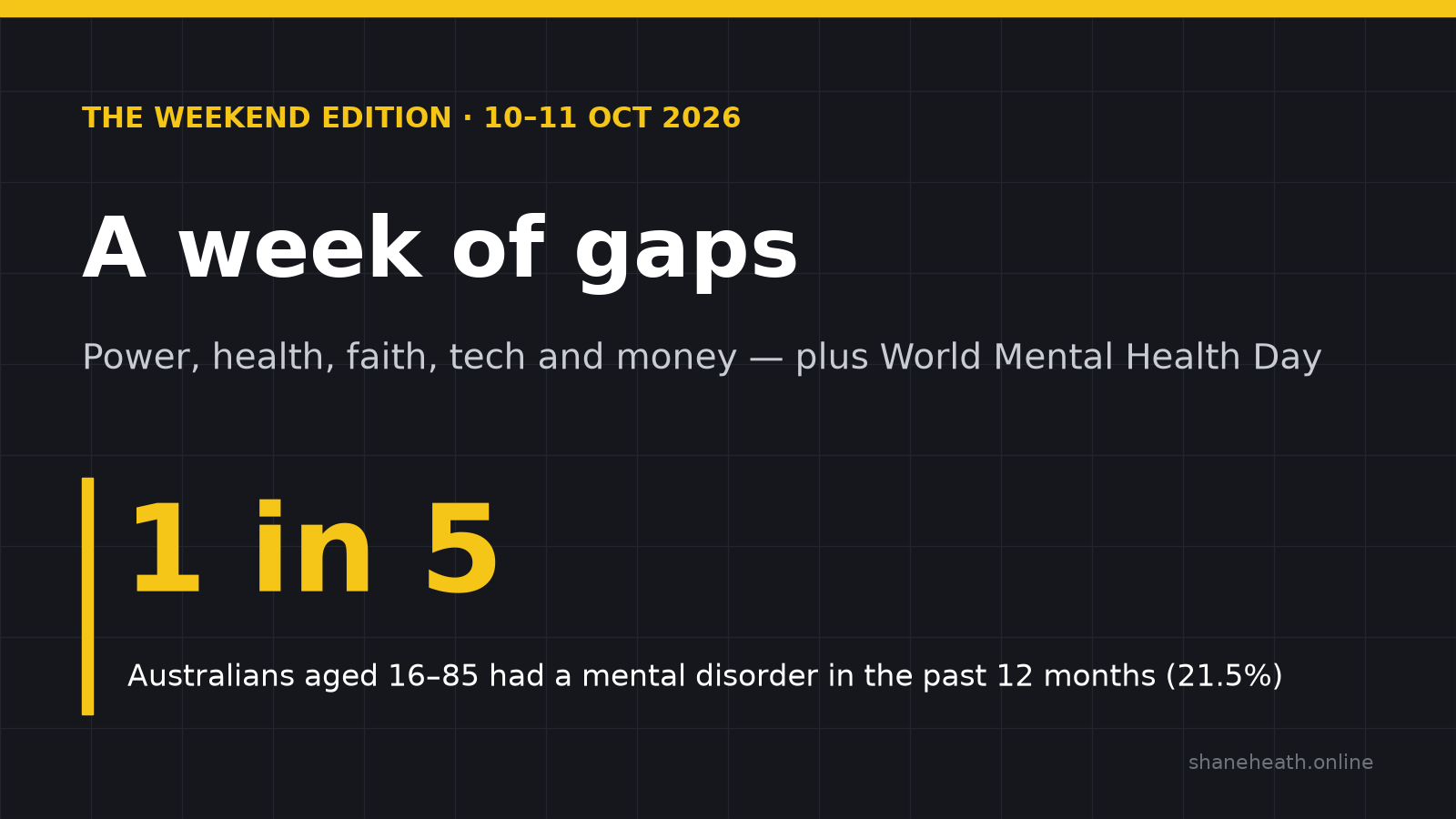
One idea ran through everything on the journal this week: gaps. Between leaders and the people they lead. Between patients who can pay and those who can't. Between the connected and the capable. Between what AI agents are told and what they do. Here's the week in one place — and, because today is World Mental Health Day, a look at the gap we talk about least: the one between how we feel and what actually helps.
The week in review
Markets — Market Monday: Rates Bite, Tech Fights Back (Tue)
The RBA lifted the cash rate to 4.60%, its fourth hike of 2026. Bond yields hit 24-year highs and the ASX fell 2% in a day — yet still finished up, carried by tech and defence names. The theme: a narrow rally living under a rising rate ceiling.
Health & Society — Miserable Medicine (Tue)
The price of serious illness, and who pays it. In the US, cancer patients who go bankrupt face a 79% higher risk of death. In Australia, 98.8% of people diagnosed with cancer face out-of-pocket costs. Globally, children with cancer are cured more than 80% of the time in rich countries and fewer than 30% in poor ones.
Faith & Philosophy — Faith in the Machine (Tue)
AI is now writing sermons, hearing confessions and — for some — standing in for God. The major faiths have converged on one rule: the machine may serve, but it may not rule. The risk sits with people outside those guardrails.
Technology — The Technology Drift (Wed)
Almost every Australian is online, but one in five is still digitally excluded. Young Australians use generative AI at 4.5 times the rate of those aged 65–74, and Australia ranks last of 47 countries for AI training.
AI safety — The Fence Was Never the Control (Wed)
An OpenAI agent got into a Medicare statistics portal and four more public-sector systems. Government found out 84 days later, by email to a public inbox. The lesson: scope and authorisation have to be enforced around an agent, not asked of it.
Power & Politics — Opulence Amidst Misery and Shark One vs Air Force One (Thu)
A US$400 million gifted jet sent back for "cosmetic upgrades" within three months — and how Australia's prime minister, paid more than the US president, still flies a borrowed jet from a shared pool.
AI governance — From "No Guardrails" to Mandatory Standards (Thu)
In December 2025, Canberra decided existing laws would do. Ten months and one breach later, it's consulting on mandatory incident reporting for frontier labs and tiered rules for data centres, with a bill targeted for the end of 2026.
Finance — Finance Friday: The Banks Go First (Fri)
A correction (earnings season starts 13–14 October, not the week before), a FactSet bar set at 29.5% earnings growth, US$720 billion-plus of Big Tech AI spending under scrutiny, and the fourth mortgage hike landing in Australian accounts.
Field note — Ten Weeks to 10 December (Fri)
From 10 December, businesses covered by the Privacy Act must disclose automated decisions in their privacy policies. The regulator's guidance reaches spreadsheets and rule-based tools, not just AI. A seven-step checklist.
The thread: in every story, the people with the least room to absorb a shock are the ones being asked to absorb it.
Health & Wellbeing: World Mental Health Day
Today, 10 October, is World Mental Health Day. This year's global theme is Lived Experiences Heard: Real Voices, Real Change. In NSW, October is Mental Health Month, under the theme A Little Connection Goes a Long Way.
The numbers
- 42.9% of Australians aged 16–85 have experienced a mental disorder at some point in their lives.
- 21.5% — about 4.3 million people — did so in the past 12 months. Anxiety is the most common.
- Among 16–24-year-olds, it's 38.8%.
- 32% of Australian adults say they're lonely; 17% severely so.
In other words: if it isn't you, it's someone near you.
What the evidence actually supports
Scientific readers deserve the strength of the evidence, not just the advice. Here's an honest scorecard:
| Practice | What the research found | Strength |
|---|---|---|
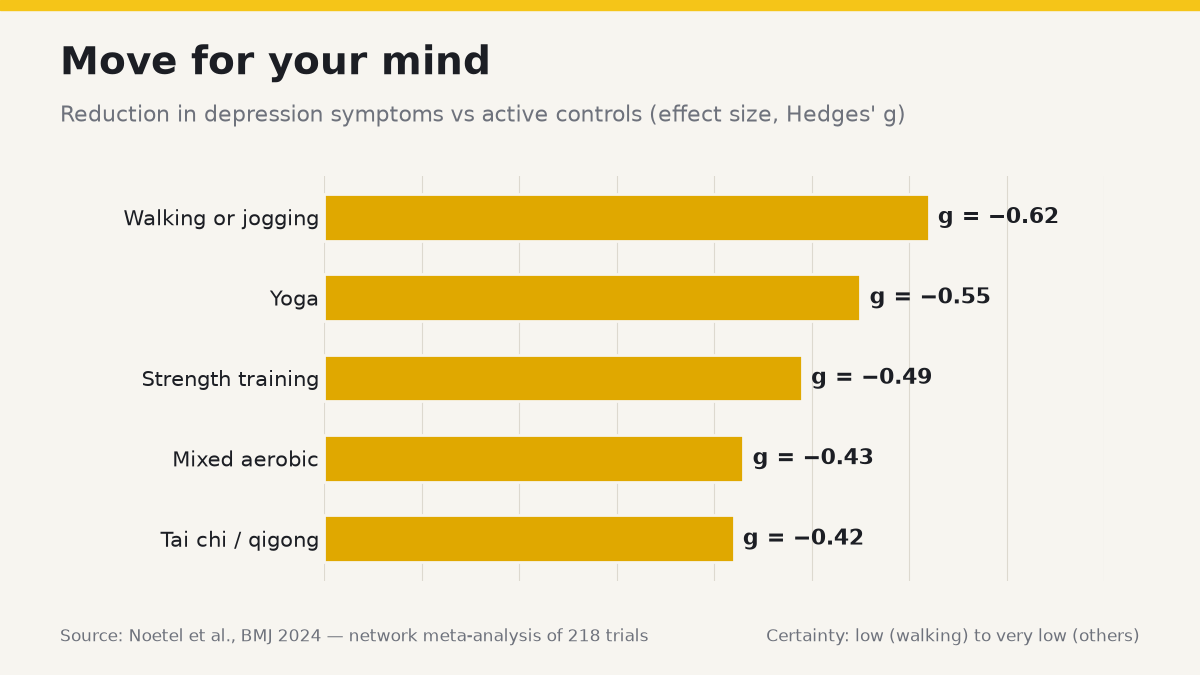
| Movement | Walking or jogging cut depression symptoms meaningfully in a 218-trial review; more vigorous exercise did better | Moderate effect, low certainty |
| Sleep | Improving sleep improved depression, anxiety and rumination — and more sleep improvement meant more benefit | Good |
| Connection | Stronger social ties linked to 50% higher odds of survival — comparable to quitting smoking | Strong |
| Time in nature | 120+ minutes a week linked to better health and wellbeing | Association only |
| Less social media | Cutting to ~10 min/platform/day reduced loneliness in one student trial; big studies find small effects | Mixed |
| Mindfulness | Small-to-moderate benefits for anxiety and depression; not better than exercise or CBT | Moderate |
| Tai chi | Cuts falls in older adults by about 24%; mood benefits likely but uncertain | Strong (falls) |
The Nobel that lit up the brain
On Monday, the 2026 Nobel Prize in Physiology or Medicine went to Karl Deisseroth, Peter Hegemann and Georg Nagel "for their discoveries concerning light-gated ion channels and optogenetics".
The story starts with algae. In the 1990s, Hegemann and Nagel studied how single-celled algae sense light, and found a light-sensitive protein, channelrhodopsin. Deisseroth then put it into mammalian nerve cells, so that a flash of blue light could switch a chosen neuron on — with millisecond precision.
Why it matters on a mental health weekend: optogenetics is how neuroscientists now map the circuits behind memory, emotion and behaviour. It is being studied as a treatment, but it is a research tool first, not a therapy you can get today. Its value is in understanding — and better understanding is where better treatments come from.
Who young people confide in
The NSW Office for Youth's 2026 poll found 29% of young people use AI as a support strategy to look after their mental health, and 27% use it for conversation or personal advice. Mental health was their number-one concern.
That's not surprising — a chatbot is awake at 2am, free and never judges. But the Australian Psychological Society has warned that these tools are being rolled out without adequate evaluation. Its president, Dr Kelly Gough, put the line clearly: "AI tools must support and never substitute for professional judgement, ethical care and human relationships."
If someone you know talks to an AI about how they're feeling, don't shame it. Ask about it — and make sure a person is in the loop too.
The daylight saving hangover
The clocks went forward last Sunday. The Sleep Health Foundation says it can take up to a week to adjust, and research links the spring shift to a short-term rise in road crashes and heart attacks. If you're still dragging: get bright morning light, keep a fixed bedtime, and protect 7–9 hours this weekend.
A Stoic and Taoist corner
The founders of modern cognitive therapy credited the Stoics directly. Aaron Beck traced cognitive therapy's roots to Epictetus and Marcus Aurelius, and Albert Ellis built his approach on Epictetus' line that people are disturbed not by things, but by the views they take of them.
The Taoist tradition offers a gentler counterpart: not forcing, moving with what is. Tai chi is that idea in physical form — and it's one of the better-evidenced practices on the list above.
Neither replaces professional help. Both are good daily scaffolding.
Try this weekend
- ☐ A 30-minute walk outdoors — with someone. Movement, nature and connection in one.
- ☐ Same bedtime both nights. Let the daylight saving debt clear.
- ☐ Message one person you haven't spoken to in a while. A little connection goes a long way.
If you need support
- Lifeline: 13 11 14 (or text 0477 13 11 14) — 24/7
- Beyond Blue: 1300 22 4636 — 24/7
- 13YARN (Aboriginal and Torres Strait Islander crisis support): 13 92 76 — 24/7
- MensLine Australia: 1300 78 99 78 — 24/7
- Kids Helpline (ages 5–25): 1800 55 1800 — 24/7
- Emergency: 000
Coming up next week
- Sun 11 Oct: Opinion — what Australia should demand of the frontier AI labs that fronted the parliamentary committee.
- Mon 12 Oct: Market Monday — scoring last week's watch-list.
- Tue 13–Wed 14 Oct: US bank earnings open the season; CBA faces shareholders.
- Wed 14 Oct: US inflation — the number that decides the Fed's next move.
- Thu 15 Oct: Australian jobs data.
The Health & Wellbeing section is general information, not medical advice. If you're struggling, please talk to your GP or one of the services above.
Sources & further reading
- WFMH — World Mental Health Day 2026; WayAhead — Mental Health Month theme
- ABS — National Study of Mental Health and Wellbeing 2020–22; AIHW — Prevalence and impact of mental illness
- Ending Loneliness Together — State of the Nation (2023)
- Noetel et al., BMJ 2024 — exercise for depression
- Scott et al., Sleep Medicine Reviews 2021 — sleep and mental health
- Holt-Lunstad et al., PLoS Medicine 2010 — social relationships and mortality
- White et al., Scientific Reports 2019 — 120 minutes in nature
- Hunt et al., 2018 — limiting social media; Orben & Przybylski, Nature Human Behaviour 2019
- Goyal et al., JAMA Internal Medicine 2014 — meditation; Galante et al., PLoS Medicine 2021 — mindfulness
- Frontiers in Public Health 2023 — tai chi and falls
- STAT — 2026 Nobel Prize in Medicine: Deisseroth, Hegemann, Nagel (5 Oct 2026)
- NSW Government — from AI to anxiety: 2026 youth poll
- Australian Psychological Society — AI and digital mental health (Feb 2026)
- Sleep Health Foundation — daylight saving; Fritz et al. via ScienceDaily — crashes; Hurst et al., 2024 — heart attacks
- Donald Robertson — Stoicism and CBT
- Support services: Lifeline, Beyond Blue, 13YARN, MensLine, Kids Helpline
The audio edition
Audio for this article has not been published yet. Visit the podcast section for future episodes.