Modern medicine can now cure diseases that were death sentences a decade ago. The catch: some of those cures cost more than a house in Sydney. So what happens to the people who can't pay?
The short answer, across the evidence: they wait, they ration, they borrow, they crowdfund — and some of them die sooner than they would have.
This piece looks at what serious illness actually costs, how three different systems handle it (the US, Australia and the developing world), and what the data says about outcomes when the money runs out.
1. The price tags
First, a reality check on what "serious treatment" now costs. These are list or subsidy prices, before hospital stays, scans and follow-up care.
| Treatment | Condition | Price |
|---|---|---|
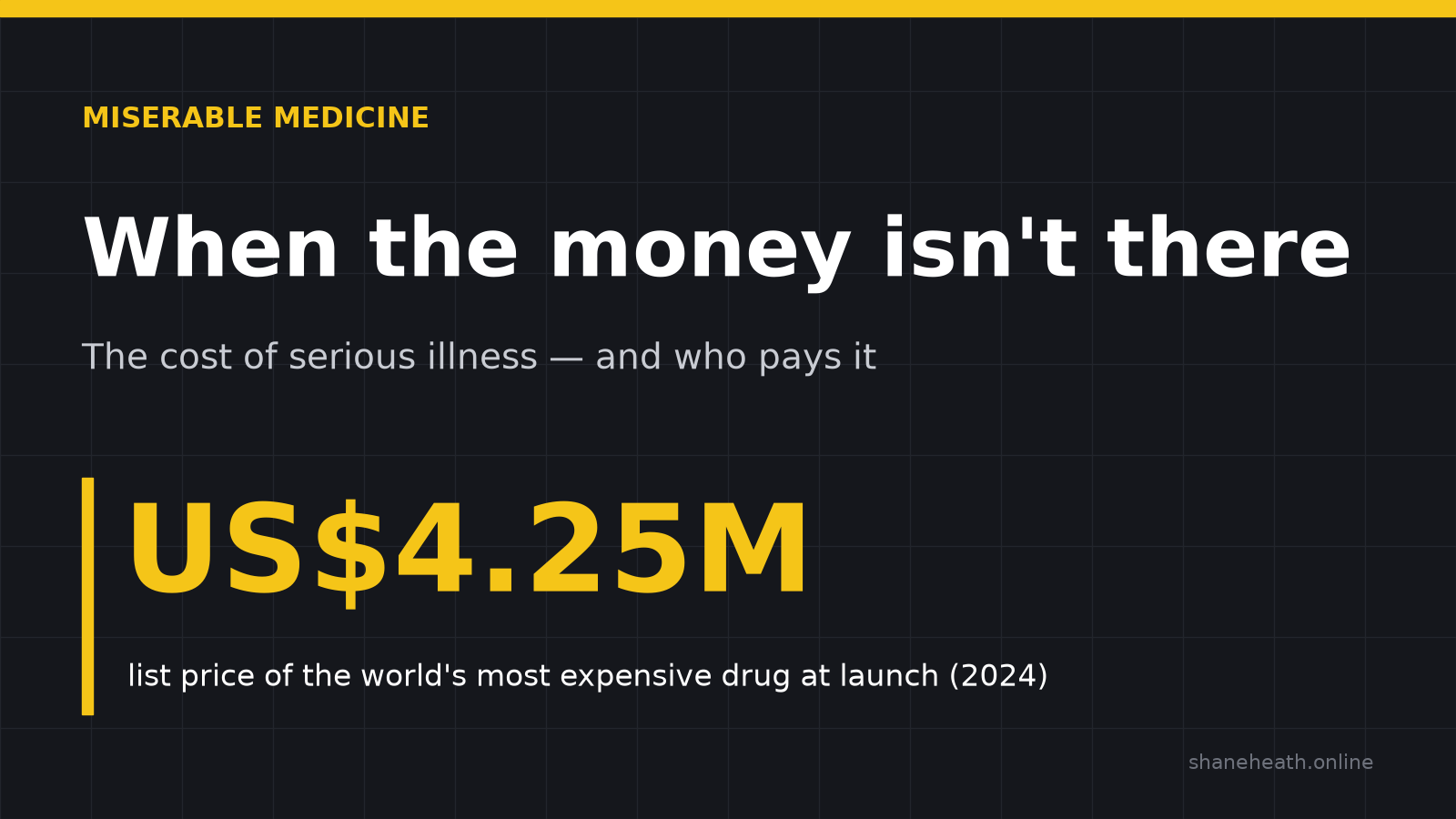
| Lenmeldy (gene therapy) | Metachromatic leukodystrophy | US$4.25M — world's most expensive drug at launch (2024) |
| Hemgenix (gene therapy) | Haemophilia B | ~US$3.5M (~A$5.3M) |
| Casgevy (gene therapy) | Sickle cell disease | US$2.2M |
| Zolgensma (gene therapy) | Spinal muscular atrophy | ~US$2.1M (~A$2.5M unsubsidised) |
| Double-lung transplant (US billed charges) | End-stage lung disease | ~US$2.3M |
| CAR-T therapy (Kymriah) | Blood cancers | ~US$475,000 for the drug alone |
| Keytruda (immunotherapy) | Many cancers | ~US$218,000 a year at US list price* |
*My calculation: US$12,517 per three-weekly dose, run for a year.
Two patterns stand out:
- One-off cures are the new frontier. Gene therapies promise to fix a disease once — but they charge for a lifetime of value up front.
- America pays more for the same molecule. RAND found US prescription drug prices average 2.78 times those in 33 other OECD countries — and 4.22 times for brand-name drugs. US insulin was nearly 10 times the OECD average before rebates.
2. America: where cost becomes a cause of death
The US is the cleanest natural experiment for "what happens when the money isn't there", because so much of the cost lands on individuals.
The scale
- 26.7 million Americans (7.9%) were uninsured in 2025.
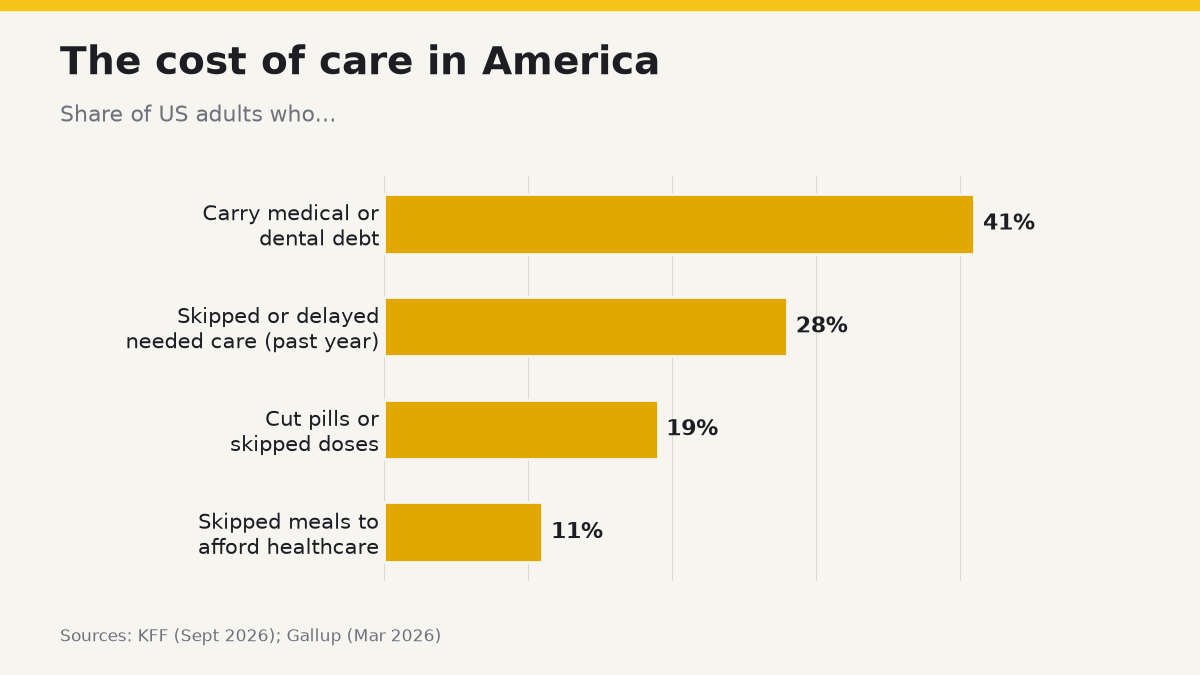
- 41% of US adults carry medical or dental debt.
- 28% skipped or postponed needed care in the past year because of cost — rising to 62% of the uninsured under 65.
- 19% cut pills in half or skipped doses to make a prescription last.
- 11% — about 28 million people — skipped meals to afford healthcare (Gallup, 2025).
- Americans borrowed an estimated US$74 billion in 2024 to pay for care.
The outcomes
This is the part that matters most. Rationing isn't just uncomfortable — it's measurable in lives.
- Bankruptcy and survival. A landmark study of cancer patients in Washington State found those who went bankrupt after diagnosis had a 79% higher risk of death than matched patients who didn't. For colorectal cancer, the risk was roughly 2.5 times higher.
- Financial hardship and survival. A national study of 25,000+ cancer survivors found those reporting medical financial hardship had 15–17% higher mortality.
- Insulin. Around 1.3 million American adults with diabetes rationed insulin in 2022. (Since then, US$35 monthly caps for Medicare and manufacturer price cuts have eased this — proof that policy works.)
A fair caveat
The often-quoted claim that "two-thirds of US bankruptcies are medical" is contested. A 2018 New England Journal of Medicine study argued hospital stays directly cause only about 4% of bankruptcies in non-elderly adults — the rest is correlation (people already struggling get sick too). The honest read: medical costs are a major contributor, even if not always the single cause.
3. Australia: universal, but not free
It's tempting for Australians to read the section above and feel smug. Partly fair: the Commonwealth Fund's 2024 Mirror, Mirror report ranked Australia's health system #1 of 10 high-income countries — and the US last.
But "universal" doesn't mean "free". Look closer:
Out-of-pocket is big and growing
- Australians paid A$44 billion out of their own pockets for health in 2023–24 — about A$1,634 per person, or 16% of all health spending.
- The biggest slice: A$15.8 billion on medicines not covered by the PBS.
Cancer: nearly everyone pays
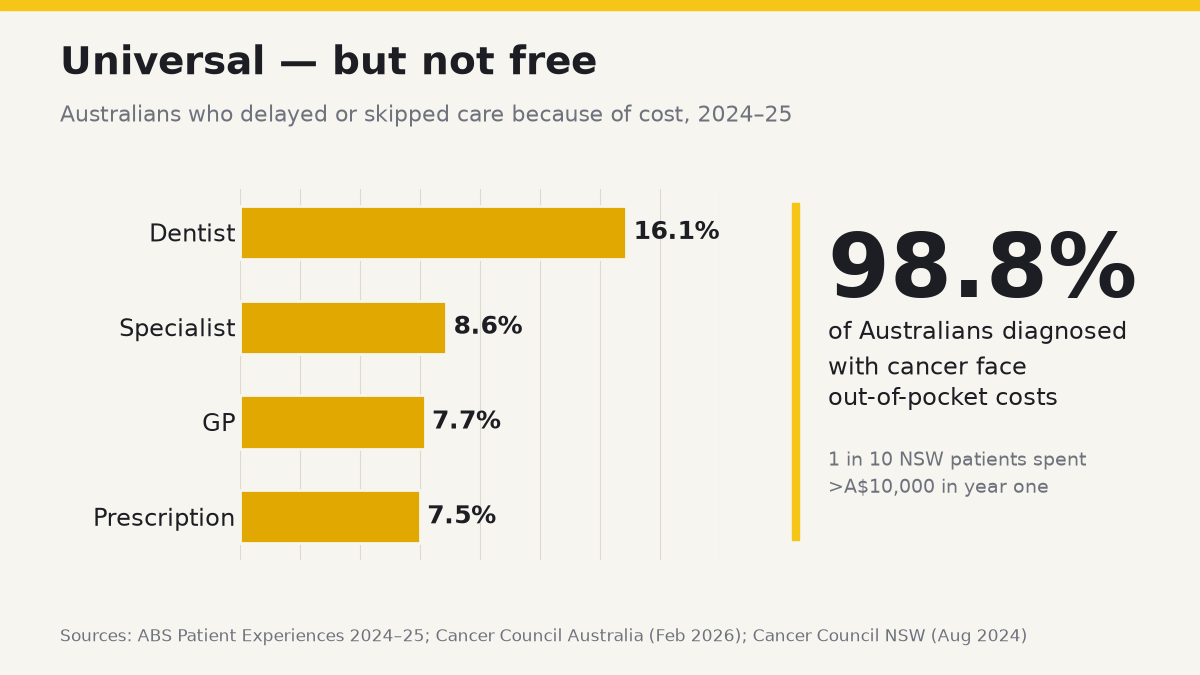
- 98.8% of Australians diagnosed with cancer face out-of-pocket costs (Cancer Council, 2026).
- 38% lose income or have their work disrupted.
- 1 in 10 NSW cancer patients spent more than A$10,000 in the first year after diagnosis.
People are still putting off care
The ABS's latest survey (2024–25) found people delayed or skipped care because of cost:
- 16.1% for dental
- 8.6% for specialists
- 7.7% for GPs
- 7.5% for prescriptions
And the gaps are not evenly spread:
- Women delay specialist care at almost double the rate of men (10.8% vs 5.7%).
- People in the most disadvantaged areas delay dental care at 2.4 times the rate of the least disadvantaged (23.1% vs 9.6%).
The good news
Credit where due — several things have genuinely improved:
- Cheaper scripts. The PBS co-payment dropped from A$31.60 to A$25 on 1 January 2026.
- Bulk billing is rising. GP bulk billing hit 84.1% in the June 2026 quarter, with a 90% target by 2030.
- Fewer people delaying. Cost-related delays fell across all four categories in 2024–25.
- Big-ticket drugs get funded. The PBS covers Zolgensma for eligible babies and spent over A$680 million on Keytruda in 2024–25.
Where the system draws the line
But there is a line. In 2024, the government's advisory body (MSAC) did not support public funding for Hemgenix, the ~A$5.3 million haemophilia B gene therapy. That's a rational decision about value for money — and also a decision that, for some patients, the cure exists but isn't theirs.
And when the system says no, Australians increasingly do what Americans do: they crowdfund.
4. GoFundMe has become a health system
This is one of the quieter scandals of modern medicine.
- GoFundMe estimates about a third of all money raised on its platform goes to illness or injury.
- US medical campaigns grew 25-fold between 2011 and 2020.
- But only 9.2% of medical campaigns reached their goal, raising on average 42% of their target (PLOS ONE study, 2016 data).
Worse, crowdfunding rewards the wrong things. Campaigns do better when the patient has a large, well-off social network, a photogenic story and strong writing skills. Researchers have repeatedly found it deepens inequality rather than fixing it — the people with the least get the least.
A health system where your survival depends on how shareable your story is — that's not a safety net. It's a talent show.
5. The world: where the gap is widest
Step back from rich countries and the picture gets much darker.
- 2.1 billion people worldwide face financial hardship from health costs.
- 1.6 billion are pushed into — or deeper into — poverty by them.
- 4.6 billion lack access to essential health services. (WHO/World Bank, 2025)
The single starkest number I found:
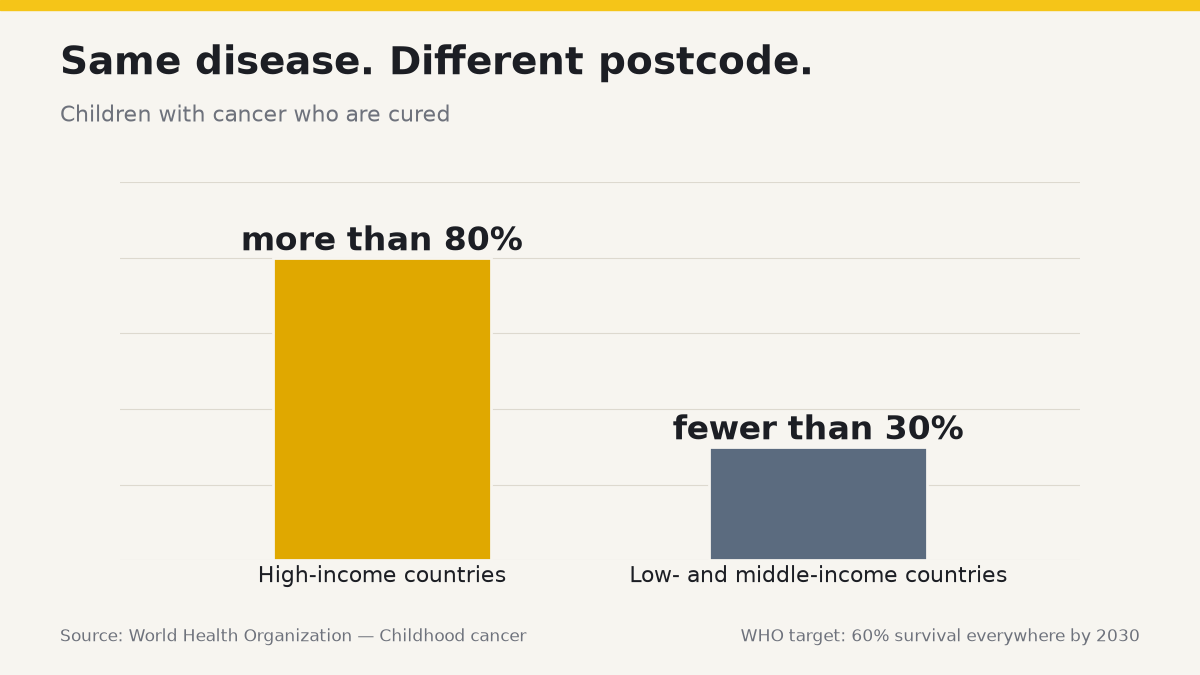
More than 80% of children with cancer are cured in high-income countries. In low- and middle-income countries, fewer than 30% are.
Same disease. Same biology. Often the same, cheap, decades-old drugs. The difference is almost entirely money, infrastructure and access. WHO estimates lifting survival to 60% everywhere by 2030 would save around 1 million children.
6. The case for the price tags
In fairness to the other side — and there is one:
- Drugs are expensive to invent. The median cost to bring a new drug to market is about US$985 million, counting failed attempts (JAMA, 2020). Most candidates fail.
- One-off cures can be cheaper long-term. A gene therapy that replaces decades of hospital care can be cost-effective even at millions of dollars. The US cost-effectiveness body ICER found sickle cell gene therapies would be good value at roughly US$1.6–1.9 million.
- Rare diseases mean tiny markets. Some therapies treat only a few hundred patients worldwide; the price has to recover costs from very few people.
All fair. But notice the gap: Casgevy launched at US$2.2M and Lyfgenia at US$3.1M — above what ICER calculated as fair value. The R&D argument explains why drugs are expensive. It doesn't explain why the same drug costs four times more in one country than another.
7. What would actually help
None of this is unsolvable. The evidence points to a few things that work:
- Cap out-of-pocket costs. The US insulin caps cut rationing quickly. Australia could apply the same logic to total annual cancer costs.
- Pay for outcomes, not promises. Outcome-based deals — where governments pay in instalments only while a gene therapy keeps working — spread risk and make funding "yes" more likely.
- Treat financial hardship as a clinical risk. If bankruptcy raises cancer mortality by 79%, money stress belongs in the treatment plan. Financial counselling should be standard, not optional.
- Fix the dental gap. Dental is Australia's biggest cost-delay category, and it's mostly outside Medicare.
- Back global access. The childhood cancer gap is mostly about cheap, existing drugs that don't reach the children who need them.
Verdict
Medicine has never been better. Access has never been more unequal.
At the top end, we can now rewrite a child's genes. At the bottom, children die of cancers that have been curable for decades. In between, ordinary people — in rich countries too — are splitting pills, skipping meals and running fundraisers to stay alive.
The Stoics taught that we can't control illness, only how we meet it. Fair enough for the individual. But a society can control whether the sick also have to fight their bank balance. That part is a choice — and right now, too many systems are choosing badly.
General information only, not medical or financial advice.
Sources & further reading
- Merck — Keytruda cost and financial help
- MIT Technology Review — the new most expensive drug (Mar 2024)
- IntuitionLabs — most expensive drugs in the US, 2025
- Minister for Health — Zolgensma on the PBS
- The Limbic — TGA approves Hemgenix (Mar 2024); MSAC application 1728
- Milliman — US transplant costs 2025
- RAND — US prescription drug prices (Feb 2024); RAND — insulin prices
- Fierce Healthcare — US uninsured rate (Sept 2026)
- KFF — Americans' challenges with health care costs
- Gallup — one-third of Americans cut back to cover healthcare (Mar 2026)
- West Health / Gallup — US$74B borrowed for care
- Ramsey et al., Journal of Clinical Oncology (2016)
- Yabroff et al., JNCI (2022)
- STAT — 1.3 million Americans rationed insulin (Oct 2022)
- Dobkin et al., NEJM (2018) — medical bankruptcies
- Commonwealth Fund — Mirror, Mirror 2024
- AIHW — Health expenditure Australia 2023–24
- Cancer Council Australia — out-of-pocket costs (Feb 2026)
- Cancer Council NSW — one in ten spending $10,000 (Aug 2024)
- ABS — Patient Experiences 2024–25
- Health Partners — PBS co-payment change (Jan 2026)
- Medical Republic — bulk billing rate (Aug 2026)
- Pharmacy Daily — top PBS drugs 2024–25
- Fortune — GoFundMe has become a health care utility (Feb 2024)
- PLOS ONE — social inequities in medical crowdfunding (2020)
- University of Washington — crowdfunding and the uninsured (2022)
- World Bank / WHO — Tracking UHC: 2025 Global Monitoring Report
- WHO — Childhood cancer
- BioSpace — median cost of bringing a drug to market (JAMA, 2020)
- CGTLive — ICER on sickle cell gene therapy value
The audio edition
Written by Shane Heath. Narrated by Maren Solberg · 14:43. AI-generated narration.