Continental drift is too slow to notice — until one day there's an ocean between two coastlines that used to touch. Technology is doing the same thing to people. And the gap is opening faster than most of us realise.
This isn't the old "digital divide" story about who has internet. Almost everyone in Australia is online now. The new gap is about who understands what they're using — especially AI — and who's quietly being left behind.
1. Online, but not included
Start with the good news: 99.7% of Australian adults went online in the six months to June 2025 (ACMA). Even among people aged 75+, mobile internet use has jumped from 18% in 2017 to 88%.
Now the catch. The Australian Digital Inclusion Index 2025 — which measures access, affordability and ability — found:
- 20.6% of Australians are digitally excluded, and 9.2% are highly excluded.
- Among people aged 75+, two in three are excluded (66.5%).
- People who didn't finish high school: 54.5% excluded.
- Public housing residents: 45.2%.
- First Nations people: 40.9% — with the gap widening to 22.8 points in very remote areas.
And a Good Things Foundation survey (October 2025) adds texture:
- 1 in 3 Australians can't tell AI-generated content from real content. For grandparents, it's 43%.
- 19% struggle to use government services online.
- More than 1 in 10 feel overwhelmed by technology.
Takeaway: having a phone isn't the same as being able to use it safely, confidently and to your advantage.
2. The AI gap is the new frontier
Generative AI arrived in late 2022. In under four years it has split the population.
By age
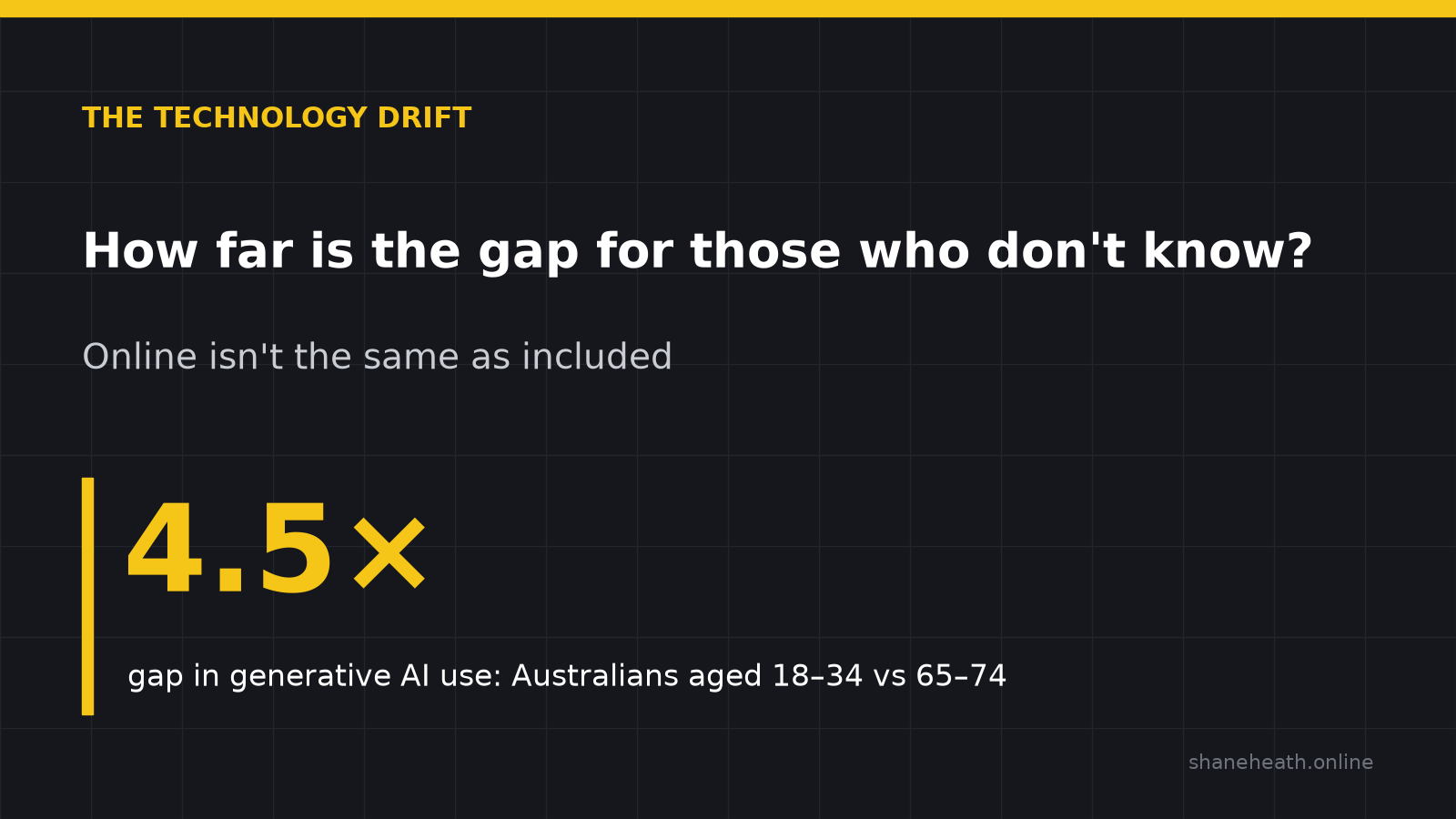
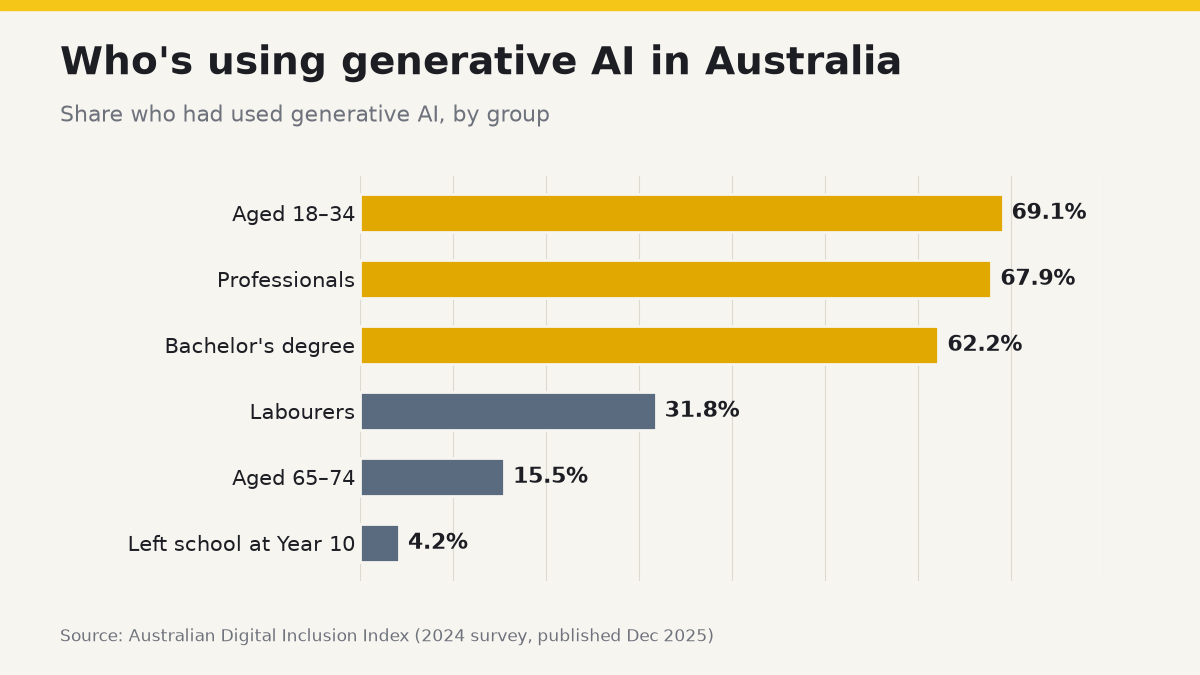
- 69% of Australians aged 18–34 had used generative AI, versus 15.5% of those aged 65–74 — a 4.5× gap (ADII, 2024 survey).
- A newer Roy Morgan survey (March 2026) found 58% of Australians aged 14+ used AI tools in a typical month — 74% of 25–34-year-olds but only 31% of over-65s.
By education and job
- 62% of people with a bachelor's degree use generative AI. Among people who left school at Year 10, it's 4.2%.
- Professionals use it at 68%; labourers at 32%; machinery operators at 27%.
By gender
Globally, men have been about 22% more likely than women to use generative AI — a gap that hasn't closed since early 2025 (Harvard Business School review, 2026).
By region
AI use isn't even spread across Australia either. One usage index (for Anthropic's Claude) found NSW and Victoria well above the national average, and the Northern Territory at about one-tenth of it. (That's one product's data, so treat it as a signal, not a census.)
3. Australia's strange position
Here's the paradox. Australia is a fairly heavy user of AI by world standards — and one of the least prepared.
- Adoption: Microsoft ranks Australia 11th globally, with about 40% of the working-age population using AI (Q1 2026). On Anthropic's per-person measure, Australia was 7th.
- Preparation: in the KPMG / University of Melbourne Trust in AI study (47 countries, 2025), Australia came dead last on two measures: only 24% had any AI training (global average 39%), and only 30% believe AI's benefits outweigh its risks.
- More than 60% of Australians report low AI knowledge.
And at work, the gap shows up as risky habits:
- 48% admit using AI against company policy.
- 57% rely on AI output without checking it.
- Only 30% of organisations have a generative AI policy.
Translation: lots of Australians are using a powerful tool they don't trust, weren't trained on and don't verify. That isn't adoption. It's exposure.
4. What the gap costs
The drift isn't abstract. It shows up in pay packets, jobs and bank balances.
Pay
- Jobs requiring AI skills now pay a 62% wage premium (PwC, 2026) — up from 57% a year earlier.
- AI-exposed sectors grew productivity 34% (2018–25), versus 24% for the least exposed.
Jobs
- A Stanford study found US workers aged 22–25 in AI-exposed jobs saw a 13% relative drop in employment — while older workers in the same roles held steady. The losses concentrate where AI replaces tasks rather than assists with them.
- Jobs and Skills Australia found the most exposed Australian roles are clerical, administrative and entry-level — many held by women — and flagged older workers, First Nations people and people with disability as facing extra risk.
Scams
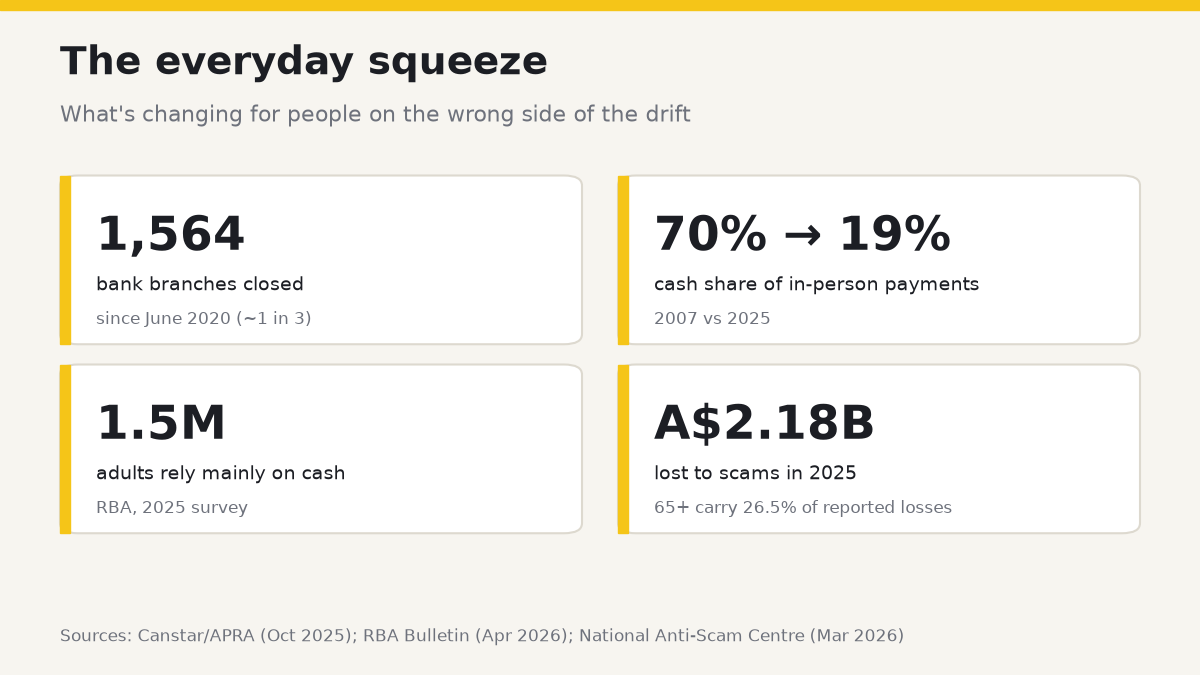
- Australians lost A$2.18 billion to scams in 2025, up 7.8% on 2024.
- Investment scams alone took A$838 million.
- People aged 65+ are about 17% of the population but account for 26.5% of losses reported to Scamwatch.
- As AI makes fakes cheaper and more convincing, the people least able to spot them are the ones most targeted.
5. The everyday squeeze
For people on the wrong side of the drift, the world is quietly rearranging itself around them.
- Bank branches: about 1 in 3 Australian bank branches has closed since mid-2020 (1,564 gone). Regional closures are now paused until at least 2030 for some banks, and Bank@Post covers about 3,300 post offices.
- Cash: cash was about 70% of in-person payments in 2007. It's now about 19%. But around 1.5 million adults still rely mainly on cash — and a quarter of people aged 65+ use it for everything.
- Government services: myGov's app passed 10 million users in 2026, and more services are moving online-first. Digital ID stays voluntary, with alternatives — but for many older Australians, "alternative" increasingly means a long wait, a long drive, or a grandchild.
One in three grandparents now relies on grandchildren for tech help. That's not a support system. It's a single point of failure.
6. The global drift
Zoom out and the gap gets wider still.
- 2.2 billion people — about a quarter of humanity — are still offline (ITU, 2025). 96% of them live in low- and middle-income countries.
- 94% of people in high-income countries are online, versus 23% in low-income ones.
- 5G covers 84% of people in rich countries and 4% in poor ones.
- Only 32 countries host AI data centres, and about half of them sit in just five. Around 95% of AI chips come from US companies.
- The AI usage gap between the Global North and South is growing, not shrinking — from 9.8 points to 12.1 points in a year (Microsoft).
The digital revolution was meant to be a great leveller. On current trends, AI risks being a great amplifier — of whatever advantages you already had.
7. The case for hope
It's not all drift. There's real evidence the gap can close — and that AI itself can help close it.
- AI helps the least experienced most. In a study of 5,000+ customer-support agents, AI lifted productivity 14% on average — but 34% for novice and lower-skilled workers. A Harvard/BCG study found below-average consultants improved 43% with AI.
- Older Australians are catching up fast. Digital ability scores for people aged 75+ almost doubled between 2023 and 2025.
- Programs work. The government's Be Connected program has now helped 3 million Australians aged 50+ build digital skills, through around 4,000 community partners.
- AI is reaching the bush in unexpected ways. Remote Australians are more than twice as likely as city dwellers to use chatbots for social connection.
One important caveat from that same Harvard/BCG study: on tasks outside the AI's abilities, people using it made more mistakes. Real AI literacy isn't just knowing how to use the tool. It's knowing when not to trust it.
8. What would actually narrow the gap
- Teach judgement, not just buttons. The biggest Australian gap isn't access — it's training and trust. AI literacy should cover verification, privacy and scam-spotting, not just prompts.
- Keep a human door open. Every essential service going digital should keep a phone line or counter that actually works.
- Protect cash and regional branches for the people who still depend on them.
- Workplace policies, now. With 70% of organisations lacking an AI policy and half of staff using AI anyway, the risk is already inside the building.
- Use AI to teach AI. The studies show it lifts beginners most. Patient, plain-English AI tutors could be the best catch-up tool we've ever had — if we point them at the right people.
Verdict
The gap isn't between people with technology and people without it. It's between people who understand the tools shaping their lives and people who are simply subject to them.
That second group is older, poorer, more regional and less educated — and AI is about to make their world faster, more automated and more full of convincing fakes.
The drift is slow enough to ignore and fast enough to matter. Unlike continents, people can still be brought back together — but only if we decide it's worth building the bridges.
Sources & further reading
- Australian Digital Inclusion Index — the 2025 findings
- Australian Digital Inclusion Index — "Australia is facing an AI divide" (Dec 2025)
- RMIT — Digital Inclusion Index 2025 release (Nov 2025)
- ACMA — How we use the internet (Feb 2026)
- Good Things Foundation — Australian attitudes to getting online 2025
- Roy Morgan — AI tools usage (Mar 2026)
- Harvard Business School D^3 — the gender divide in generative AI (Aug 2026)
- Anthropic — How Australia uses Claude (Mar 2026)
- Microsoft — AI Diffusion Report, Q1 2026
- Stockhead — Australians less trusting of AI than most countries (KPMG / University of Melbourne)
- PwC — 2026 Global AI Jobs Barometer
- Stanford SIEPR — Canaries in the Coal Mine
- ACS Information Age — Jobs and Skills Australia generative AI study (Aug 2025)
- National Anti-Scam Centre — Targeting Scams
- Canstar — bank branches fall by 155 in a year (Oct 2025)
- YourLifeChoices — regional branches and Bank@Post
- RBA Bulletin — Cash use in Australia (Apr 2026)
- Biometric Update — myGov app passes 10 million users (Aug 2026)
- ABC News — older Australians and the digital divide (Aug 2026)
- ITU — Facts and Figures 2025
- Sherwood News — AI data centre concentration
- Brynjolfsson, Li & Raymond — Generative AI at Work (NBER)
- VentureBeat — Harvard/BCG study of GPT-4 and consultants
- eSafety — Be Connected helps 3 million older Australians (Oct 2026)
The audio edition
Audio for this article has not been published yet. Visit the podcast section for future episodes.