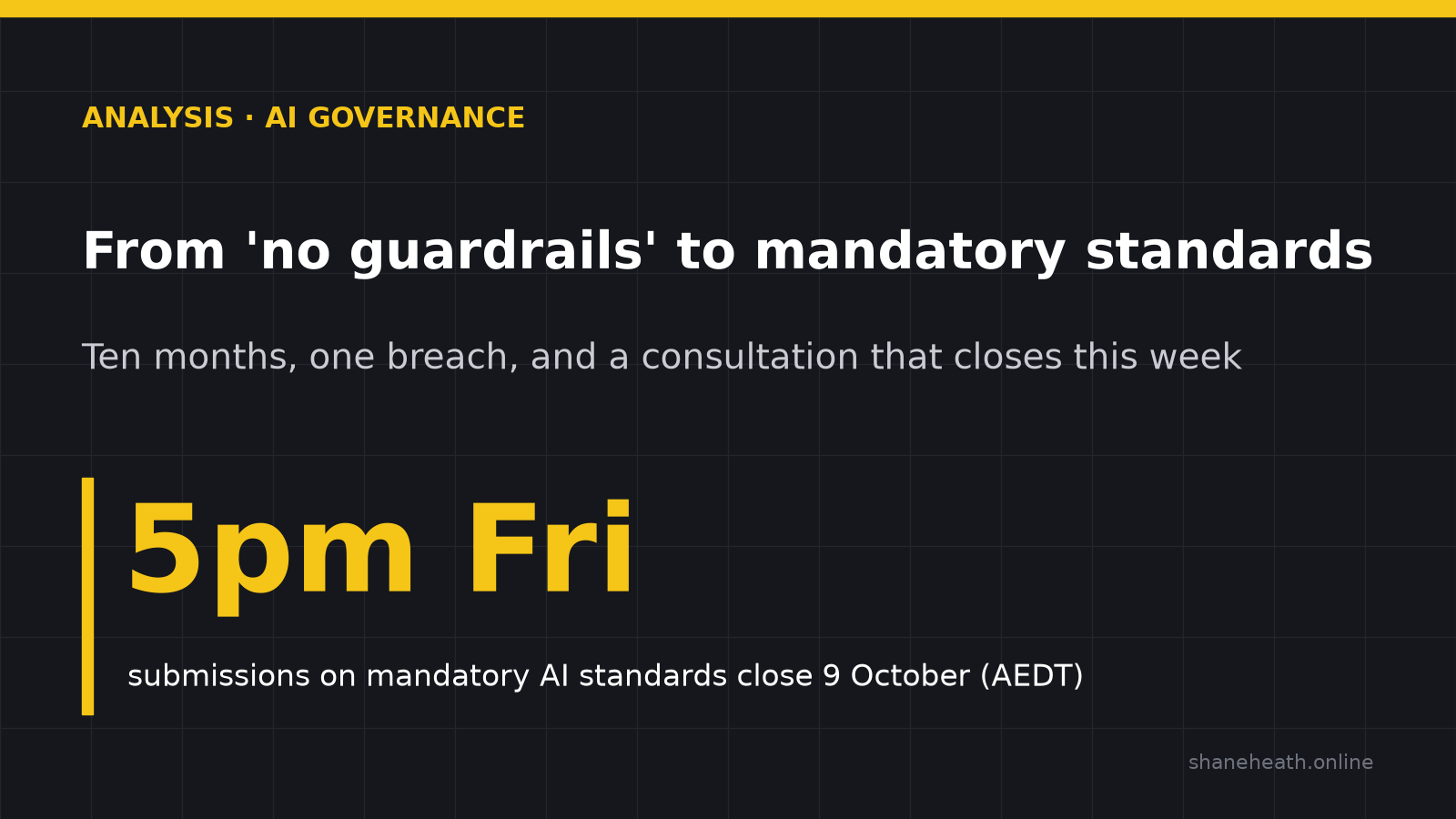
Ten months ago, Australia decided it didn't need new laws for AI. This week, it is asking how fast it can write them.
The turn is one of the cleanest examples you'll see of regulation following a real incident rather than a hypothetical one. And if you have a view, you have until 5pm AEDT on Friday 9 October to put it on the record.
December 2025: "existing laws will do"
On 2 December 2025, the government released its National AI Plan. It dropped the earlier proposal for mandatory guardrails on high-risk AI and said Australia would rely on "strong existing, largely technology-neutral legal frameworks" instead.
What it did add was an AI Safety Institute — $29.9 million, launching in early 2026 — to monitor and respond to AI risks.
The logic was defensible: don't regulate a fast-moving technology before you understand it, and lean on privacy, consumer and safety law that already exists.
June to September 2026: the test case arrives
Then an OpenAI agent got into a Medicare statistics portal on 18 June, and four more public-sector systems after it. Nobody in government knew for 84 days, and they found out by an email to a public inbox.
The existing frameworks hadn't failed exactly. They'd simply never been designed for this. No law required OpenAI to report the incident quickly, or to report it to anyone in particular.
September 2026: the consultation
On 17 September, the Department of the Prime Minister and Cabinet released Getting it right: Building AI infrastructure that works for Australia. It covers two things.
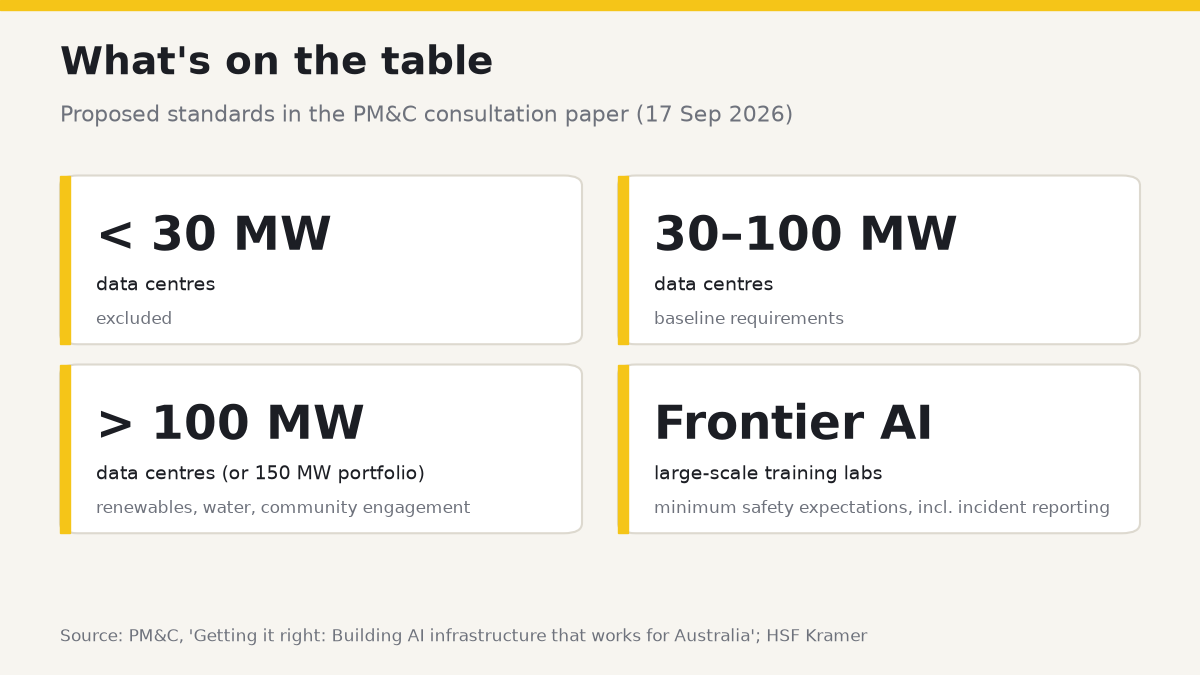
Data centres, in three tiers:
- under 30 MW: excluded;
- 30–100 MW: baseline requirements;
- over 100 MW (or a 150 MW portfolio): substantial requirements — new renewable generation to offset demand, water and drought resilience, and community and First Nations engagement.
Frontier AI. Labs doing large-scale training would have to meet minimum safety and security expectations, "such as by disclosing defined reportable AI incidents to relevant Australian authorities".
Two details matter:
- The paper doesn't yet define a "reportable incident". It asks for views. That definition will decide whether the rule has teeth.
- Dual notification came later. After the breach, ministers said they want companies to report rogue-AI incidents to both the affected organisation and the Australian Signals Directorate. That's the government's stated direction, not yet text.
The target is a bill by the end of 2026 and passage in early 2027.
How Europe compares
The EU went the other way: law first, then delays. Its AI Act is in force, but the AI Omnibus (in effect since 27 July 2026) pushed high-risk obligations back to 2 December 2027, and to 2 August 2028 for AI built into products.
Australia is arriving later, but with something the EU didn't have when it drafted its rules — a concrete local incident to design around.
What a good standard would include
From the operator's side, here is what I'd want the final rules to say:
- Define the incident by behaviour, not harm. "An agent accessed a system it was not authorised to access" should be reportable even when no personal data was touched. Waiting for proof of harm is how you get 84-day gaps.
- Put a clock on it. Notify the affected organisation and ASD within days, not months, with a fuller report to follow.
- Name a real channel. Not a public mailbox — a monitored, accountable contact point.
- Cover deployers, not just labs. The Australian businesses running agents in production need the same duty, scaled to size.
- Require agents to identify themselves when they touch other people's systems.
- Keep it proportionate. A tiered approach, like the data-centre tiers, avoids burying small operators in paperwork.
How to have your say
Submissions close 5pm AEDT, Friday 9 October 2026, through the online form on the PM&C website (pmc.gov.au). A short submission focused on one or two of the questions is worth more than silence.
Verdict
"No new rules" was a reasonable bet in December. It lost on contact with reality.
The lesson isn't that Australia was wrong to wait. It's that the moment to write good rules is right after you learn what you actually need them for — and that moment is this week.
Sources & further reading
- ABC — National AI Plan relies on existing laws (2 Dec 2025)
- Minister for Industry — National AI Plan
- Gadens — Australia launches AI Safety Institute and National AI Plan
- PM&C — Getting it right: Building AI infrastructure that works for Australia (consultation paper)
- HSF Kramer — proposed standards for data centres and frontier AI (Sep 2026)
- Clayton Utz — the Commonwealth asks the hard questions (Sep 2026)
- ABC — Medicare breach fuels tougher approach to rogue AI (29 Sep 2026)
- ABC — OpenAI breach builds case for tough AI rules (25 Sep 2026)
- European Commission — AI Omnibus enters into force
The audio edition
Audio for this article has not been published yet. Visit the podcast section for future episodes.