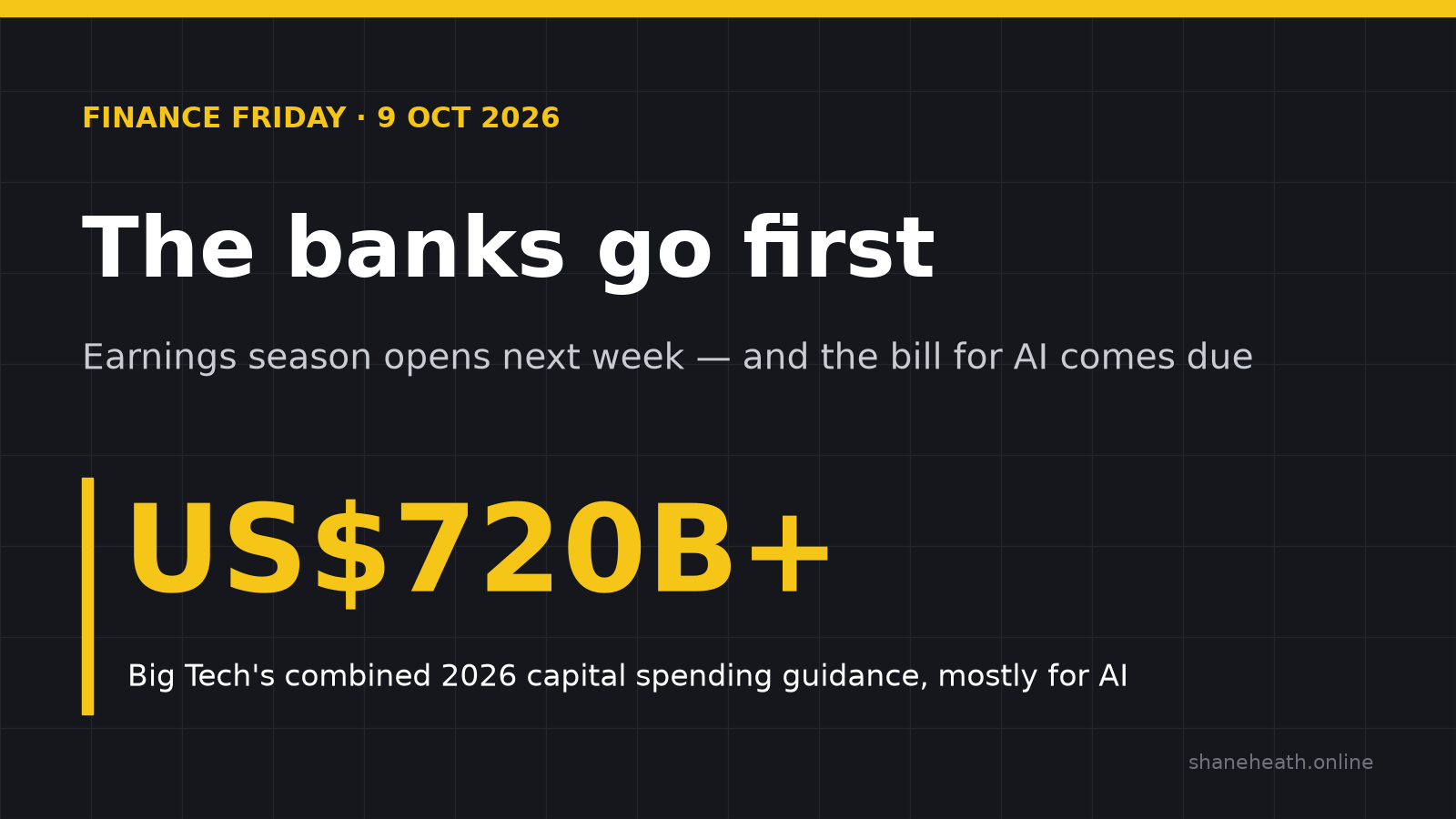
Earnings season opens next week. Expectations are sky-high, Big Tech's AI spending is bigger than ever, and Australian borrowers start paying the fourth rate hike of 2026 from today.
First, a correction
Last Friday I wrote that earnings season formally begins the week of 7–11 October. That was wrong. This week was only the curtain-raiser — PepsiCo, Delta, Constellation Brands, Levi's and AI datacentre operator Applied Digital.
The real starting gun is Tuesday 13 October, when JPMorgan, Citi and Goldman Sachs report, followed on Wednesday 14 October by Wells Fargo, Bank of America, Morgan Stanley and BlackRock.
The argument from last week stands: this season is a test of whether the AI spend is paying for itself. The date just moves back a week.
The week that was
A choppy week that ended on a sour note for AI. Figures are to Thursday's close (Friday morning, Australian time):
| Market | Level | Week |
|---|---|---|
| ASX 200 | 8,660 | about +0.5% over five sessions, after a 0.8% fall on Thursday as miners slid |
| S&P 500 | 7,765 | +0.6% — off Tuesday's record |
| Nasdaq | 27,193 | flat — a 1.3% drop on Thursday wiped out the week's gains |
| US 10-year yield | 5.23% | still near its highest since 2002 |
| AUD/USD | about 69.5 US cents | |
| Brent crude | about US$103 | Middle East supply jitters |
The Thursday sell-off in chips (Nvidia, Micron, Intel) followed a Financial Times report that OpenAI's annualised revenue is about US$20 billion below earlier estimates. That is exactly the "show-me" test this column has been describing, arriving a week early.
- Fed minutes (released Thu 8 Oct, AEDT): the Fed raised rates to 3.75–4% in September, 12–0. "Most participants" think another hike is likely by year end, with inflation still "elevated" (PCE 3.8%).
- Applied Digital (Wed 7 Oct, US time): revenue up 322% to US$342 million and about US$36 billion of contracted leases. The early read on AI datacentre demand is strong, though the company is still loss-making on a reported basis.
- PepsiCo (Thu 8 Oct): beat on revenue (US$25.3 billion, +5.6%) but cut its full-year profit-growth outlook to 2.5–3% and cut Lay's and Doritos prices by up to 15%. Shoppers are pushing back on price.
- Westpac consumer sentiment (Tue 6 Oct): down 4.7% to 80.4. People surveyed after the RBA's hike scored just 67.2.
What we knew going in: the US 10-year yield touched 5.34% last week — its highest since 2002 — before easing to around 5.18% after a weak US jobs report (only 29,000 jobs added in September). Higher-for-longer rates remain the backdrop for everything below.
The bar is set high
Markets aren't walking into this season nervously. They're walking in expecting a lot. According to FactSet (2 October):
- Earnings growth: S&P 500 companies are expected to grow earnings 29.5% on a year ago — the third straight quarter above 25%.
- Revenue growth: expected at 12.3%.
- Guidance: 62% of companies that issued guidance raised it — the highest share since FactSet began tracking in 2006 (the long-run average is about 40%).
- Valuation: the forward price-to-earnings ratio is 19.0 — actually below the 5-year average (19.8).
What it means: this isn't a market priced on fantasy multiples. It's priced on very strong expected growth. That's a different risk. When expectations are this high, a merely good quarter can be punished.
The AI bill comes due
Here's the core of last week's thesis — the "story stocks versus show-me stocks" split. The spending is now enormous:
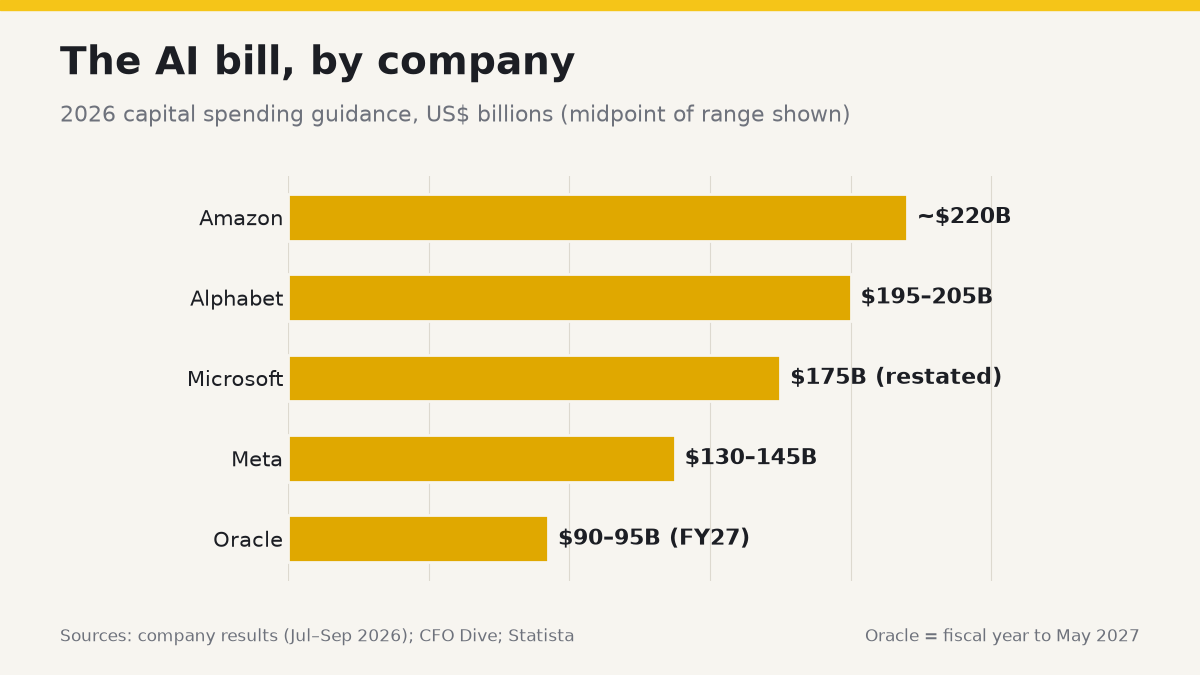
Combined, the four largest US tech companies are guiding to roughly US$720–760 billion of capital spending in 2026 — nearly double 2025's US$413 billion. Most of it is datacentres and chips.
The "show-me" evidence is starting to appear:
- Alphabet spent a record US$44.9 billion in one quarter and posted negative free cash flow of US$5.9 billion. The shares fell after results — even though Google Cloud revenue grew 82%.
- Oracle has a US$664 billion contracted backlog, but negative free cash flow of US$5 billion last quarter, and it has been raising money by selling new shares (a US$20 billion program).
- A McKinsey finding cited by Forbes: only 37% of firms report a measurable earnings impact from AI so far.
None of this proves a bubble. It does show the market starting to ask when the payback arrives — and to mark down companies whose cash is flowing out faster than it's coming in. The big tech reports start around 28 October. That's the real exam.
Closer to home: the fourth hike lands today
The big four banks — CBA, NAB, Westpac and ANZ — all passed on the RBA's full 0.25% rise to variable home loans, effective today, 9 October. Macquarie follows on 15 October.
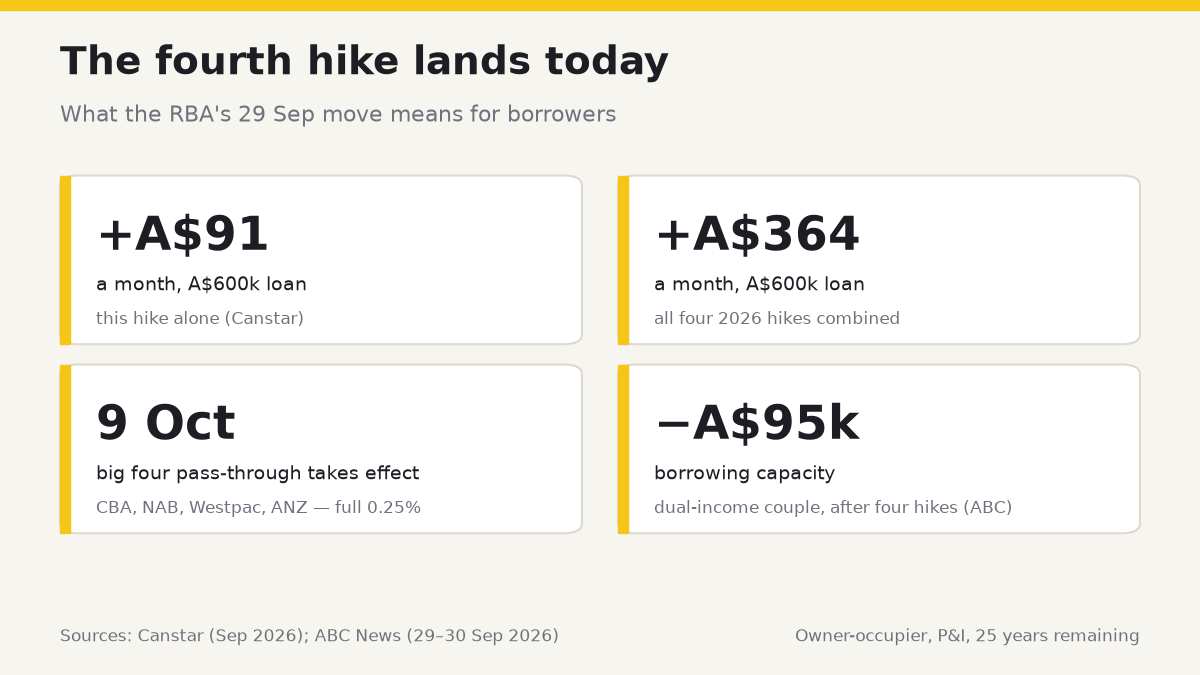
On a typical A$600,000 owner-occupier loan, this hike adds about A$91 a month. All four of this year's hikes together add about A$364 a month — roughly A$4,300 a year.
Borrowing capacity has shrunk too: about A$47,000 less for a single earner and A$95,000 less for a dual-income couple (ABC).
The banks themselves report soon: Westpac on 2 November, NAB on 5 November, Macquarie on 6 November and ANZ on 9 November.
Key dates for next week
| Date | Event | Why it matters |
|---|---|---|
| Tue 13 Oct | JPMorgan, Citi, Goldman Sachs results (US morning) | Earnings season starts; read on loan demand and dealmaking |
| Tue 13 Oct | Telstra AGM; RBA minutes (expected) | How close the RBA came to a bigger move |
| Wed 14 Oct | Wells Fargo, Bank of America, Morgan Stanley, BlackRock | Consumer credit health and investor flows |
| Wed 14 Oct | CBA and Origin AGMs | Australia's biggest bank faces shareholders after four hikes |
| Wed 14 Oct | US inflation, September (8:30am US time) | Decides whether the Fed hikes again in late October |
| Thu 15 Oct | Australian jobs data, September | A key input for the RBA's 3 November meeting |
What to watch in your own portfolio
Not advice — just the questions I'm asking this season:
- Cash, not just growth. For any big AI spender you hold, is free cash flow positive — and is the gap closing or widening?
- Guidance over the headline. With 62% of guidance already raised, the forward outlook matters more than the beat.
- Rate sensitivity. With 10-year yields above 5%, how exposed are your holdings to rates staying higher for longer?
- Your own mortgage. Today's repayment rise is real cash. Check your new repayment and whether your offset or buffer still holds.
General commentary only, not personal financial advice. It does not take into account your objectives, financial situation or needs; consider those, and seek licensed advice, before acting.
Sources & further reading
- This week: Yahoo Finance — markets, 8 Oct; ABC — ASX close, 8 Oct; Federal Reserve — FOMC minutes, 15–16 Sep; Applied Digital — FQ1 2027 results; Quartz — PepsiCo; Westpac IQ — consumer sentiment, Oct
- Company IR: JPMorganChase; Citi; Goldman Sachs; Wells Fargo; Bank of America; Morgan Stanley; BlackRock
- FactSet — S&P 500 earnings season preview, Q3 2026; FactSet Earnings Insight (2 Oct)
- AI capex: MLQ.ai — Alphabet; Amazon Q2 call; Meta Q2; CFO Dive — Microsoft; Oracle Q1 FY27; Statista; Forbes (28 Sep)
- Rates: Quartz — 10-year at 2002 high; Quartz — jobs report; BLS release schedule; ABS release calendar; RBA calendar
- Mortgages: Canstar; ABC — what the hike means; ABC — banks pass on hike
- Australian calendar: Telstra; CBA; Origin; Westpac; NAB; ANZ; Macquarie
The audio edition
Audio for this article has not been published yet. Visit the podcast section for future episodes.