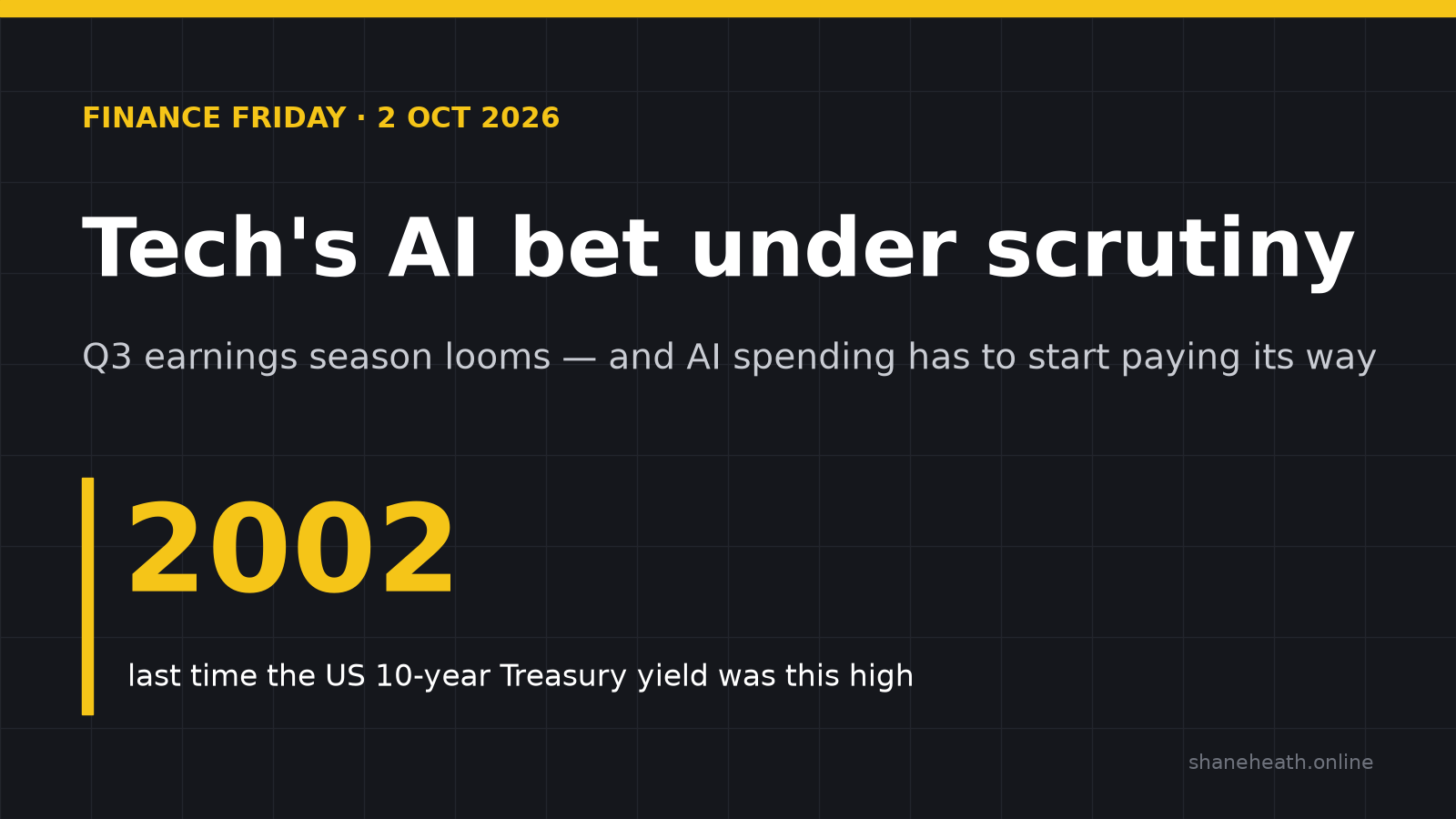
The end of September saw equity markets navigate a delicate tightrope: defending recent tech-driven gains while contending with 24-year yield highs that threaten to undermine valuation math. As October begins, investors are entering earnings season with one overarching question: have companies' massive investments in artificial intelligence infrastructure finally started translating into measurable return on capital?
The Week That Was: Tech Holds Ground Despite Rate Pressures
U.S. stock indices managed gains this week, with technology shares proving surprisingly resilient despite a bond market sending warning signals. Yields have climbed to levels not seen since 2002, reflecting a market that is slowly repricing expectations for future Federal Reserve policy and long-term growth. Traditional value sectors gained traction, but the Magnificent Seven narrative—mega-cap tech stocks carrying outsized portfolio weight—retained investor favor through a combination of narrative confidence and genuine earnings quality.
The disconnect is worth noting: as borrowing costs rise and the competitive landscape for AI talent and infrastructure intensifies, equities are pricing in a scenario where large-cap tech can maintain operating leverage despite inflationary pressures on capex. This is not a certainty. Ford's CEO publicly acknowledged this week that the line between engineers and skilled tradespeople is "completely blurred" in an AI-driven world, hinting at labor and structural economy shifts that earnings reports will need to address.
The October Earnings Test: AI Spending Rationalization
Q3 earnings season arrives with extraordinary importance. For the first time since the AI boom accelerated in late 2022, markets will pressure management teams to demonstrate that massive datacenter buildouts, GPU procurement, and research investments are yielding measurable business impact—not just technological prowess. Companies that cannot articulate a credible path to monetizing AI spending face potential re-rating, regardless of recent share price strength.
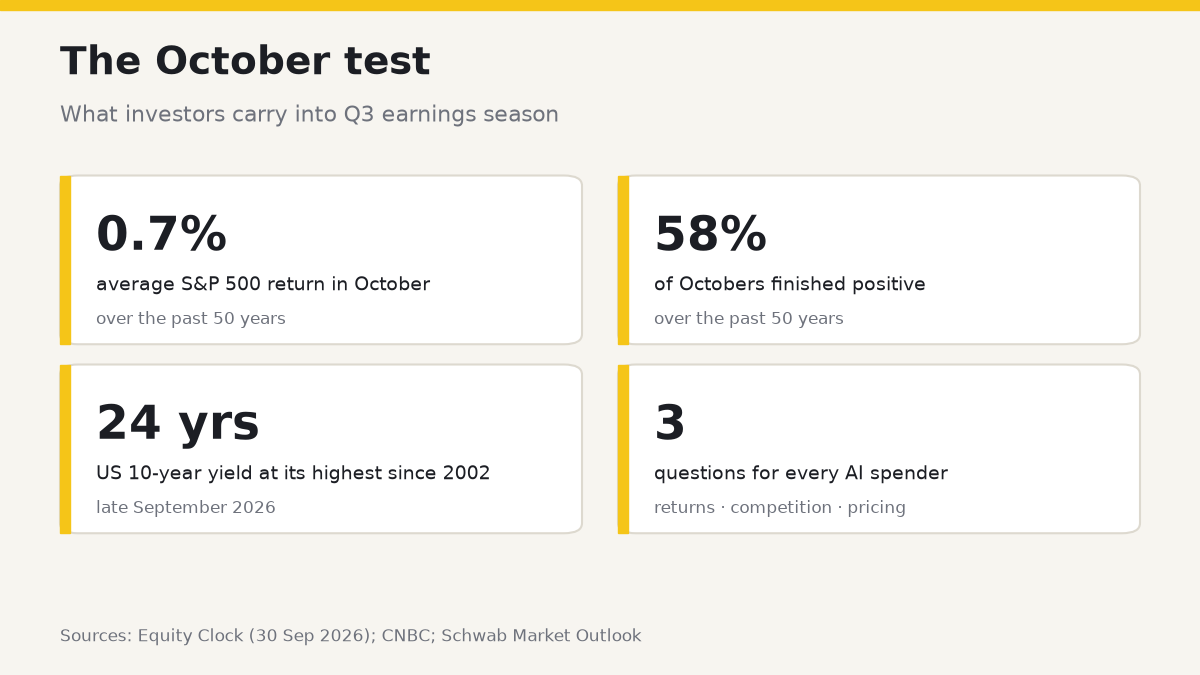
Three critical questions will dominate earnings calls: (1) Are capital-intensive AI infrastructure investments delivering genuine productivity gains or incremental revenue? (2) How are competitive dynamics in AI shifting market structure? (3) When will utilization and pricing for AI services stabilize and become predictable enough for long-term planning? Vague answers will be punished.
The historical context is important: the S&P 500 has averaged 0.7% returns in October over the past 50 years with positive gains occurring 58% of the time. October is not typically a volatile month by design, but when combined with elevated rates, elevated equity valuations in specific sectors, and earnings uncertainty, conditions exist for meaningful drawdowns if guidance disappoints.
Looking Ahead: The Investment Thesis Gets Real
Next week brings the formal start of earnings season in earnest. Major financial institutions will report first, setting tone for the broader market. The week of October 7-11 will be pivotal: banks' capital return plans and deposit/lending outlooks, combined with preliminary glimpses of corporate spending intentions, will establish the narrative for Q4.
For investors, the playbook is clear. Equity valuations in large-cap tech have run ahead of normalized earnings multiples—justified only if AI investments materially accelerate corporate profit growth in 2027 and beyond. Companies demonstrating disciplined capex allocation, clear ROI frameworks for AI spending, and realistic timelines for monetization should outperform those offering aspirational narratives without demonstrated traction.
The bond market's signal is real: yields at 24-year highs imply either higher rates for longer or weaker growth. Equities cannot have it both ways. Earnings season will determine which scenario the market ultimately prices in.
Key Metrics for the Week Ahead
- Earnings beat rate: Watch whether companies beat consensus revenue and earnings expectations or guide lower
- Capex commentary: Management guidance on AI infrastructure and technology investment pace
- Margin pressure: Operating margin trends and commentary on labor, supply chain, and competitive costs
- Forward guidance: Full-year 2026 and 2027 EPS guidance—the real test of AI thesis credibility
- Rate sensitivity: How equity volatility correlates with bond yields as earnings flow in
What This Means for Your Portfolio
Risk management becomes paramount. If earnings disappoint, especially on AI ROI clarity, corrections could be swift. Tech exposure should be calibrated to conviction level on 2026-2027 earnings growth. Value rotation could accelerate if large-cap tech multiples cannot be justified by earnings growth rates.
Diversification across valuations matters more than narrative. The market will likely bifurcate: "story stocks" (high-growth, AI-exposed, unproven ROI) versus "show-me stocks" (demonstrated earnings quality, reasonable multiples). Both can work, but timing the rotation matters enormously.
Quality over momentum. In uncertain markets, companies with low debt, strong cash generation, and clear competitive advantages outperform momentum-driven positions. Earnings season will separate the two groups quickly.
General commentary only, not personal financial advice. It does not take into account your objectives, financial situation or needs; consider those, and seek licensed advice, before acting.
Sources & further reading
The audio edition
Written by Shane Heath. Narrated by Maren Solberg · 7:05. AI-generated narration.