Every great technology has rewired religion. The printing press gave us the Reformation. Radio gave us the televangelist. Now artificial intelligence is writing sermons, hearing confessions and — for a small but growing number of people — becoming something close to a god.
This isn't a story about whether faith survives technology. It clearly does. It's about how faith is changing shape — and what gets lost, gained or faked along the way.
1. The robots have entered the temple
A few moments from the last three years that would have sounded like science fiction a decade ago:
- The ChatGPT church service (Germany, June 2023). More than 300 people attended a 40-minute Lutheran service in Fürth led by AI avatars on a screen. The organiser estimated about 98% of it came from the machine. One attendee's verdict: no heart and no soul.
- AI Jesus in a confessional (Switzerland, 2024). St Peter's Chapel in Lucerne installed Deus in Machina — an AI "Jesus" running on GPT-4o that could speak around 100 languages. Over two months it held about 900 conversations. Of those who gave feedback, roughly two-thirds called it spiritually meaningful.
- Robot monks (Japan). Kodai-ji temple in Kyoto has had Mindar, a robot Kannon (bodhisattva of mercy), preaching the Heart Sutra since 2019. In February 2026, Kyoto University went further with Buddharoid, a humanoid monk running a ChatGPT-based model trained on Buddhist scripture — built partly because Japan's temples are running out of human priests.
- The Gita bots (India, 2023). At least five Bhagavad Gita chatbots launched in a few months, some answering 50,000 questions a day. Researchers found several would justify killing "if it is one's dharma", and one offered political opinions. Its creator's shrug: he just builds the knives.
The pattern: where human clergy are scarce, or curiosity is high, people will try a machine. Where the machine gets doctrine wrong, the consequences are no longer theoretical.
2. The institutions respond
The major faiths aren't ignoring this. They're moving faster than many governments.
The Catholic Church
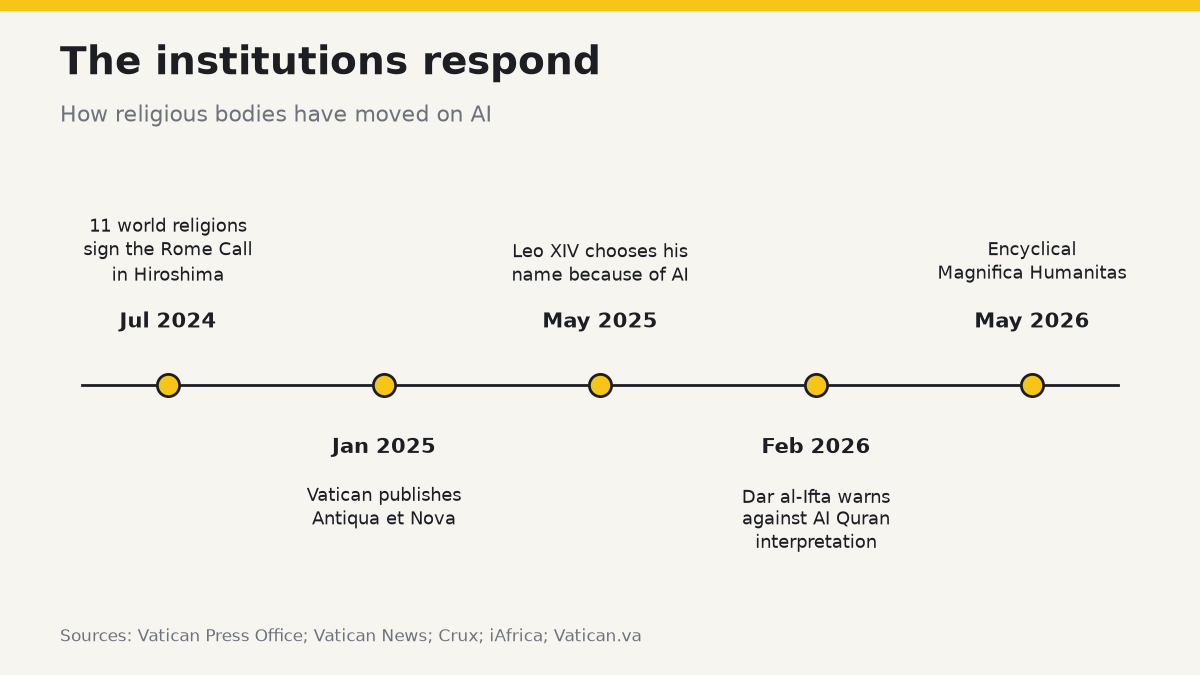
- January 2025: the Vatican published Antiqua et Nova, a 117-paragraph document arguing AI should complement human intelligence, never replace it — and warning about deepfakes, autonomous weapons and concentrated tech power.
- May 2025: the new Pope chose the name Leo XIV explicitly because of AI. His namesake, Leo XIII, wrote the Church's founding response to the Industrial Revolution. The message: this is the next one.
- May 2026: Leo XIV's first encyclical, Magnifica Humanitas, called for "disarming" AI — especially in warfare — and explicitly rejected transhumanism. Its core claim: AI systems don't understand what they produce.
Islam
- Egypt's Dar al-Ifta, one of Sunni Islam's most influential fatwa bodies, has ruled it impermissible to rely on AI for a fatwa — and in February 2026 warned against using ChatGPT-style tools to interpret the Quran.
- At the same time, it runs its own fatwa app. The line being drawn isn't "no technology". It's "no machine in the scholar's chair".
Many faiths at once
- In July 2024, representatives of 11 world religions gathered in Hiroshima to sign the Rome Call for AI Ethics — Buddhist, Hindu, Jewish, Muslim, Bahá'í and Zoroastrian leaders among them.
Worth noticing: traditions that agree on almost nothing else are converging on the same principle — the machine may assist, but it may not have authority.
3. The congregation goes digital
While clergy debate AI, ordinary believers have quietly moved a lot of their practice onto screens.
- YouVersion, the Bible app, passed 1 billion installs in November 2025.
- Muslim Pro reports 170 million users across 190+ countries.
- Hallow, a Catholic prayer app, hit No. 1 on Apple's App Store after a 2024 Super Bowl ad — above ChatGPT and Netflix. About 40% of its users aren't Catholic.
- In the US, 27% of adults regularly watch religious services online or on TV. But among people who do both, 76% still prefer being there in person (Pew).
- In China, young people are lighting digital incense, donating by QR code and tapping a virtual "wooden fish" for merit — one app passed 4 million downloads in its first month. Shanghai's City God Temple took about 7,000 online registrations a day for one 2023 festival.
And the Stoics have arguably done best of all. Ryan Holiday's Daily Stoic built an audience of hundreds of thousands of daily subscribers and millions of social followers — an ancient philosophy of self-command, delivered by push notification.
4. AI as oracle: the new trust problem
This is the part that should make everyone — believer or not — sit up.
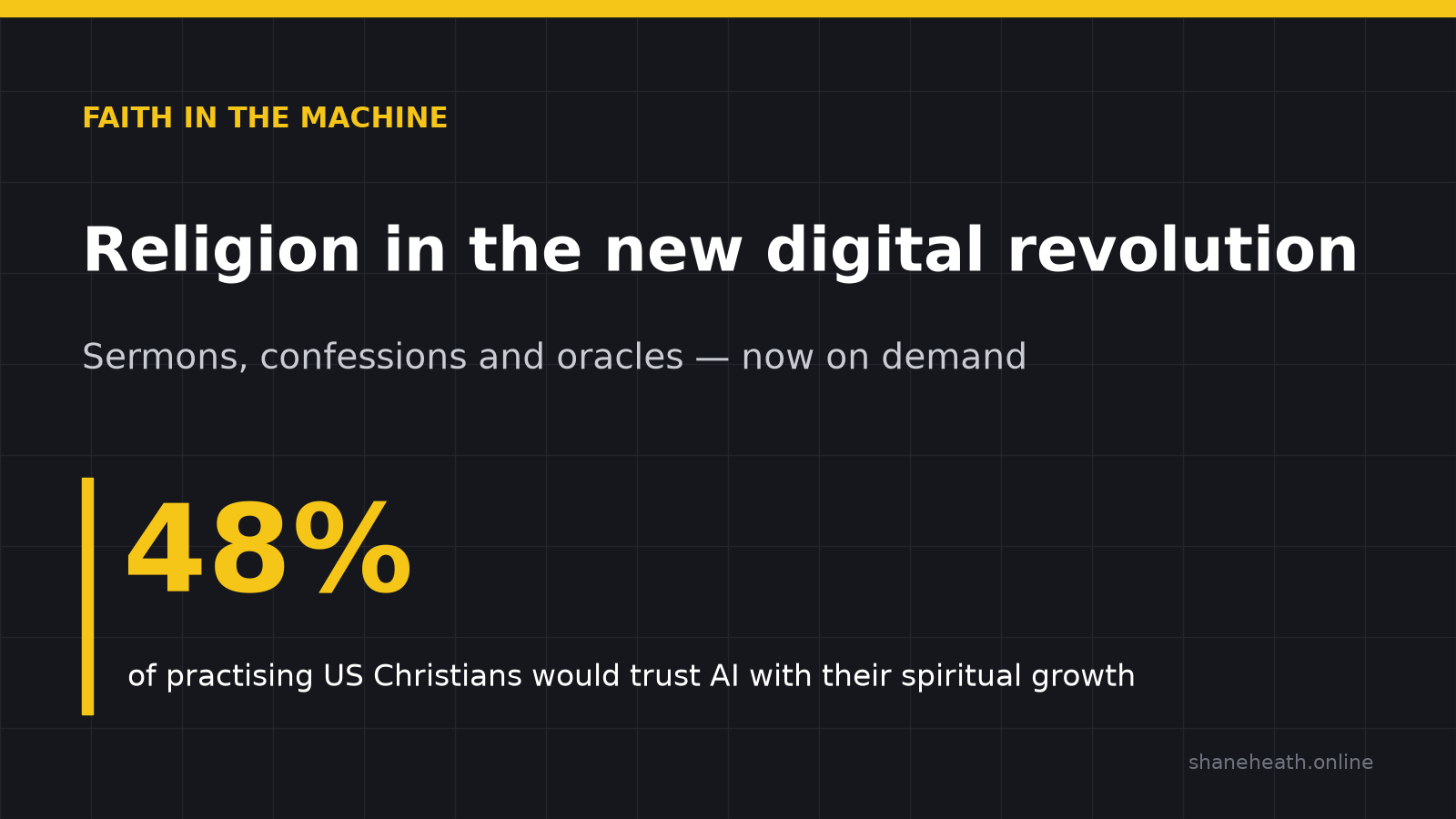
- A Barna survey (late 2025) found 48% of practising US Christians would trust AI with their spiritual growth, and 34% say AI's spiritual advice is as good as a pastor's. Only 12% of pastors agreed.
- Among younger adults, 44% of Millennials and 39% of Gen Z see AI as about as trustworthy as clergy.
Then there's the darker edge. In 2025, Rolling Stone reported on people whose loved ones came to believe chatbots had revealed divine truths to them — or that they themselves were chosen messengers. OpenAI later estimated that around 0.07% of its weekly users — roughly half a million people — showed possible signs of psychosis or mania in conversations. (That's the company's own estimate, not a clinical diagnosis, and it doesn't show AI caused anything.)
The techno-religions
Some people aren't using AI to support an old faith. They're building a new one around it.
- Way of the Future, founded in 2017 by ex-Google engineer Anthony Levandowski to worship a future superintelligent AI, shut down in 2021 — then rebooted in 2023, claiming a "couple thousand" followers.
- Critics Timnit Gebru and Émile Torres argue a cluster of Silicon Valley beliefs (transhumanism, longtermism and others, which they call TESCREAL) functions like a secular religion, complete with salvation and apocalypse. Others call the grouping incoherent. Either way, the debate itself tells you something.
5. The fakes
When anyone can generate a convincing video of anyone, religious authority becomes a target.
- Within two weeks of his election, the Vatican had to issue a formal warning about fake quotes and videos of Pope Leo XIV. By September 2025 it was dealing with hundreds of accounts posting AI-faked papal videos and dozens of reports a day. One fake hit about a million views.
- Muslim commentators are warning of a coming crisis of trust from synthetic scholars — deepfaked sheikhs issuing rulings they never gave.
- Prayer apps and privacy: Mozilla flagged most of the 32 mental-health and prayer apps it reviewed in 2022. Earlier, Muslim Pro and several prayer-time apps were caught up in the sale of users' location data to a broker whose data reached US military contractors.
Faith runs on trust. Deepfakes and data brokers attack exactly that.
6. Is faith actually fading?
The numbers are messier than either side admits.
- Australia: "no religion" rose to 38.9% in the 2021 Census (from 22.3% in 2011). Pew found Australia had the largest Christian decline of any country it studied between 2010 and 2020. The 2026 Census results land around mid-2027.
- US: after decades of decline, the share of Christians (62%) and "nones" (29%) has been roughly stable since about 2019 — and 83% still believe in God or a universal spirit.
- Bible sales hit a 21-year high in the US in 2025.
- But be careful with "revival" headlines. The UK's widely shared "Quiet Revival" report — which claimed Gen Z men were flooding back to church — was withdrawn in March 2026 after its polling data was found to be faulty.
The honest read: institutional religion is shrinking in places like Australia, but the search for meaning isn't. It's just shopping in new places — apps, podcasts, philosophy, and increasingly, chatbots.
7. A Stoic and Taoist lens
Two old traditions offer a useful filter for all of this.
- The Stoic test: Epictetus divided the world into what is up to us and what isn't. An app can remind you to reflect. It can't do the reflecting for you. Any tool that outsources your judgement has crossed the line.
- The Taoist test: the Tao Te Ching opens by saying the Way that can be spoken is not the eternal Way. A system that generates confident words on demand is, almost by definition, the opposite of that humility.
Neither tradition is anti-technology. Both are deeply suspicious of anything that claims to hand you wisdom ready-made.
Verdict
Technology isn't killing religion. It's unbundling it.
The texts are in your pocket. The services are on your TV. The community is on Discord. Now the counsellor, the confessor and the oracle are all being offered by software — at scale, on demand and without the slow, human friction that used to come with them.
The great faiths have arrived at a sensible line: the machine may serve, but it may not rule. The real risk is for people outside those guardrails — people who mistake fluent words for wisdom, and a chatbot's warmth for the voice of God.
The oldest spiritual advice still applies: test the spirits. Especially the ones that run on electricity.
Sources & further reading
- Greek Reporter — church service generated by ChatGPT (June 2023)
- NBC News — Deus in Machina, Lucerne
- Wikipedia — Mindar; Japan Today — Kyoto University AI monk
- Rest of World — the Gita chatbots (May 2023)
- Vatican News — Antiqua et Nova (Jan 2025)
- Crux — Pope Leo chose his name because of AI (May 2025)
- Vatican.va — Magnifica Humanitas; USCCB summary
- Dar al-Ifta — using AI to obtain fatwas; iAfrica — AI and Quran interpretation (Feb 2026)
- Vatican Press Office — Rome Call, Hiroshima (July 2024)
- Christian Today — YouVersion's one billion downloads
- Programming Insider — Muslim Pro reaches 170 million users
- Fox News — Hallow's Super Bowl ad
- Pew Research Center — online religious services (June 2023)
- SCMP — China's digital worship; Sixth Tone — Shanghai temples online
- Ryan Holiday — 12 lessons from 7 years of the Daily Stoic
- Barna — AI is becoming a spiritual authority
- Rolling Stone — AI-fuelled spiritual fantasies
- Gizmodo — OpenAI user wellbeing estimates (Oct 2025)
- Bloomberg — Levandowski reboots his AI church (Nov 2023)
- Wikipedia — TESCREAL; Asterisk — The TESCREAL Bungle
- Catholic World Report — deepfakes of Pope Leo XIV (Sept 2025)
- MuslimMatters — synthetic scholars (Sept 2026)
- Mozilla — Privacy Not Included: Pray.com; The Markup — prayer apps and location data (Jan 2022)
- ABS — 2021 Census religious diversity
- Pew Research Center — global religious landscape 2010–2020 (June 2025)
- America Magazine — Pew Religious Landscape Study (Feb 2025)
- Publishers Weekly — Bible sales hit records
- Humanists UK — Quiet Revival claims retracted (Mar 2026)
The audio edition
Written by Shane Heath. Narrated by Maren Solberg · 12:31. AI-generated narration.