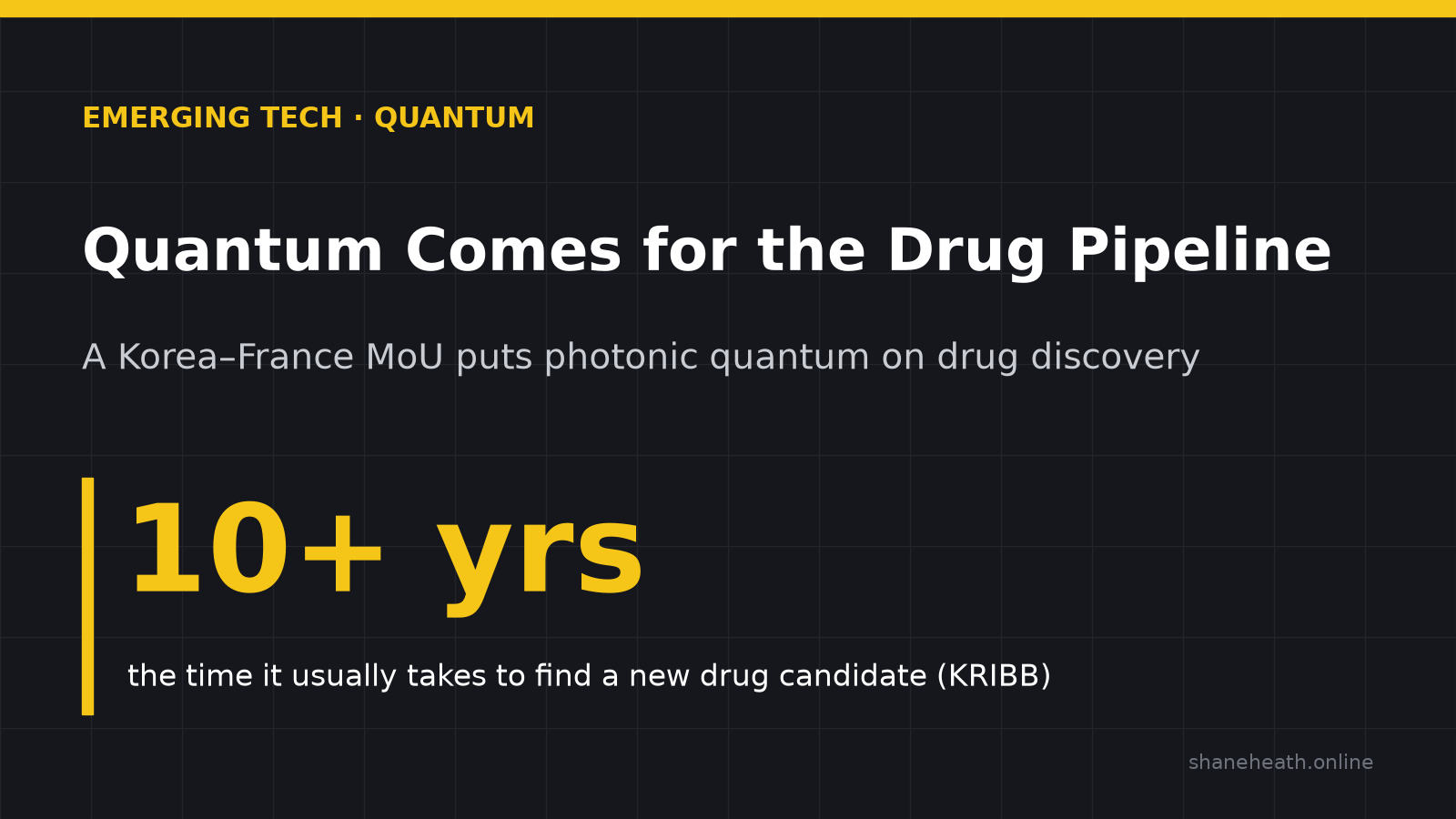
Finding a molecule that treats a disease usually takes more than a decade, and most candidates fail along the way. Last month, a Korean government research institute and a French quantum start-up agreed to find out whether quantum hardware can shorten that search.
What was signed
On 7–8 September 2026, during the Korean president's state visit to France, the Korea Research Institute of Bioscience and Biotechnology (KRIBB) signed a memorandum of understanding in Paris with Quandela, a photonic quantum computing company spun out of French national research in 2017.
The aim is to combine AI and quantum computing in biotechnology research to cut the time and cost of identifying new drug candidates. Quantum Computing Report lists the scope as proof-of-concept quantum molecular modelling for drug discovery, plus algorithm validation.
That's the honest size of it: an MoU, not a contract. No funding, milestones or timelines have been published.
Why molecules suit quantum computers
Drug discovery depends on predicting how a molecule behaves: how its electrons arrange themselves, and how strongly it binds to a target protein. Those are quantum-mechanical questions. Classical computers can only approximate them, and the cost of an exact answer grows exponentially with the size of the molecule.
A quantum computer represents those interactions natively. That's why chemistry is one of the strongest candidates for useful quantum advantage. The pitch isn't that quantum machines "try every answer at once". It's that they model a quantum system with another quantum system.
Why photonics
Quandela builds its processors around photons, made one at a time by semiconductor quantum dots. The sources still need cooling, to about 4 kelvin (−269 °C) in a compact cryostat. But the photons travel and are processed at room temperature. That's a much lighter cooling load than the dilution refrigerators superconducting machines need, running at millikelvin temperatures. It's an engineering advantage, not a free pass.
Quandela also announced a South Korean manufacturing and R&D hub for photonic processor modules in late September. KRIBB is one of the local partners listed alongside it.
Reality check
Today's quantum processors are small and noisy. Until error correction matures, they're unlikely to beat the best classical chemistry methods on real drug molecules. Expect the first outputs here to be algorithm benchmarks on small molecules rather than new medicines. Expect years of hybrid workflows, where quantum hardware handles one narrow, hard step inside a classical and AI pipeline.
That's still worth having. Pharma loses most of its money on candidates that fail late. Even a modest gain in predicting which molecules bind, and which are toxic, compounds across a whole pipeline.
Why it matters
The signal isn't this one MoU. It's the pattern: national research institutes, quantum hardware companies and governments putting quantum chemistry on real problems with named partners, not just in conference talks.
Quantum drug discovery hasn't arrived. But the work to find out whether it will has started in earnest. Watch for published benchmarks, not press releases.
Sources & further reading
- Korea Herald / Herald Business — KRIBB signs bio R&D MoUs in France, including Quandela (10 Sep 2026)
- Quantum Computing Report — Quandela establishes South Korea as Asian hub for photonic QPU manufacturing (29 Sep 2026)
- Quandela — Quantum dot glossary entry (operating temperature)
- Quandela — Prometheus single-photon source
The audio edition
Audio for this article has not been published yet. Visit the podcast section for future episodes.